F.H. Ayer Manufacturing Company
-
What's New (Last Updated November 21, 2026)
Recent changes to this page:
Introduction
The F.H. Ayer Manufacturing Company was a maker of arc lamp windlasses and automotive socket sets
and operated in the Chicago area.
Company History
The F.H. Ayer Manufacturing Company was founded by Fred H. Ayer in 1904 as a machine shop in Chicago Heights, Illinois.
The company was incorporated on March 23, 1906 with $10,000 capital.
The primary business of the company appears to have been the repair of large machinery such as pumps,
but the company also manufactured some products,
including arc lamp windlasses and automotive socket sets.
Arc Lamp Windlasses
Ayer was a notable inventor,
and in 1895 he applied for a patent on a self-locking windlass for electric arc lamps.
Fig. 1 shows
a notice for the F.H. Ayer windlass,
as published on page 7 of the July 1, 1896 issue of The Electrical Trade.
The text describes the operation of the windlass,
and the illustration shows the device marked "Pat. Apld. For".
Ayer received patent
590,940
in 1897.
The illustration also shows an "F.H. Ayer" marking on the cover,
suggesting that the inventor was manufacturing the device,
although this was some years prior to the founding of his namesake company.
The seller is noted as the Electric Appliance Company of Chicago.
After the formation of the F.H. Ayer Manufacturing Company,
production of the windlass transitioned to the new company.
The arc lamp windlass proved to be a successful product and remained in production at least into the mid 1920s.
Ratchets for Socket Sets
In 1913 Frederick H. Ayer received the first of several patents for a ratchet device,
suggesting that the company had started (or would soon start) making automotive socket sets.
The second and third ratchet patents were received in 1916,
and the patent illustrations show a ratchet in a tubular body with a folding Tee handle affixed at the top.
We recently (November 2026) discovered that in 1916 the company made an important connection with the
Packer Auto Specialty Company
of Chicago.
Packer Auto had been offering "Ray" brand socket sets since 1912,
and the sets were originally based on a highly touted tubular ratchet with a roller clutch mechanism.
However, the roller clutch ratchets apparently had reliability problems,
and we found strong evidence that by late 1916 Packer Auto had quietly switched to using the F.H. Ayer ratchets in its sets,
which were similar in appearance to the earlier Packer ratchets.
The details of our findings can be found in the article on Packer Auto.
The supply arrangement with Packer Auto would have been very significant for the Ayer company,
as the Ray socket sets were popular and must have sold in substantial quantities.
Around the same time as the change in ratchets,
Packer Auto also switched to using metal cases for its socket sets,
and once again this was significant for F.H. Ayer.
Although it's not clear whether F.H. Ayer was also the maker of the metal cases,
almost all of the observed Ayer socket sets have been found in cases closely resembling Ray brand cases.
So regardless of whether the cases were made by Packer Auto, by F.H. Ayer, or by an unknown third party,
the net result was that Ayer socket sets looked almost the same as Ray socket sets.
The close similarity of the Ayer socket sets with the Ray socket sets raises the possibility
that F.H. Ayer may have been the primary contract manufacturer for the Packer Auto sets,
although in Chicago there were a number of other companies that also could have supplied parts for the sets.
Fig. 2 shows
a notice for F.H. Ayer Manufacturing,
as published on page 64 of the 1923 EMF Electrical Year Book.
The text notes the company as a maker of rail bonds, automobile wrenches, and windlasses.
Rail bonds are believed to be a specialty tapered pin,
although we're not familiar with the application.
The "automobile wrenches" are presumably Ayer socket wrench sets,
of which a number of examples have been observed,
and the reference to windlasses would likely be the self-locking arc lamp windlass shown previously,
Automotive Socket Sets
Currently the only tools known to have been made by the company are pressed-steel socket sets and related tools,
which included a distinctive
Tee-handle Ratchet
based on patents by F.H. Ayer.
One of our readers reports that a large Ayer socket set also included stamped-steel open end wrenches
marked with "F.H. Ayer Mfg." on the shank.
Open-end wrenches had become a standard component for larger pressed-steel socket sets beginning with the
Mossberg No. 14 Socket Set
The F.H. Ayer socket sets appear to be not especially rare,
but somewhat curiously we have not been able to find any advertisements or catalog listings for the sets.
This leaves us with questions as to how the company managed to sell its products,
when the socket sets were first introduced,
and what models or sizes of sets were available.
The following list summarizes the limited information available for the Ayer sets.
- The only known examples of Ayer tools with identifying markings are the Tee handle ratchet,
stamped-steel open-end wrenches,
and pressed-steel sockets with an
A-Circle logo.
- Ayer socket sets are almost always found in a metal case closely resembling the Ray socket set cases.
- No advertisements or catalog listings have been found for Ayer socket sets.
- We haven't observed any examples of an Ayer socket set with the original label on the box.
- The Ayer Tee handle ratchet is frequently found in the Ray socket sets made by Packer Auto,
which we now believe is the result of a supplier agreement with F.H. Ayer from 1916 on.
It's also possible that owners of earlier Ray sets might have replaced a failed ratchet with the
similar F.H. Ayer model.
- The Ayer ratchet has been observed in an otherwise anonymous socket set,
with no markings on the sockets and an unmarked metal case very similar to the Ray socket set cases.
We can offer a plausible explanation for the absence of advertising for the Ayer sets.
We know that F.H. Ayer was supplying ratchets (and possibly other components) to Packer Auto in 1916 and later,
which would have made the Packer company an important customer for Ayer.
Thus when Ayer decided to offer socket sets of its own,
they would have wanted to avoid overt competition that might upset its major customer,
and this may have lead to an agreement not to advertise the Ayer sets.
Since the Ayer socket sets were not even marked,
they were effectively anonymous or generic sets that might be sold as a "house brand" by a distributor.
We think that there probably are catalog listings for Ayer socket sets,
but without any clues for easy identification of the maker.
Although we haven't found any descriptions or specifications for Ayer socket sets,
from the connection with Packer we can surmise that the Ayer sets were probably similar to the Packer models,
so that everything would fit in the same metal cases.
And based on the Packer connection,
the probable timeline for the Ayer sets would be 1916 to the mid 1920s.
Later History
Interestingly enough, the F.H. Ayer company remains in business today,
and their web site offers an informative page on the
Company History
[Sorry, dead link 😢].
Trademarks
F.H. Ayer Manufacturing is not known to have registered any trademarks.
Tool Identification
The only tools known to have been marked as Ayer production are the tubular Tee-handle ratchets,
open-end wrenches (included in some socket sets),
and pressed-steel sockets stamped with the
A-Circle logo.
Other components found in Ayer sockets sets (such as the extension and universal) were typically not marked.
If any of our readers have found another type of tool marked for Ayer,
please let us know via email!
Since Ayer socket sets were basically identical to Ray socket sets except for markings,
in some cases it may be difficult to determine the original brand.
If the set has an Ayer ratchet and mostly Ayer sockets,
and there are no decals on the case,
then it's probably an Ayer set.
But if the set has mostly Ray sockets, or a Ray flat ratchet, or a Ray decal on the case,
then it probably should be considered as a Ray set.
If neither of these cases apply and a set has an Ayer ratchet and mostly anonymous sockets,
we would be inclined to call it an Ayer set,
though obviously with less certainty.
Once a socket set has been identified as an Ayer set,
the next step is to determine the Ray-equivalent model number by checking the
descriptions in the section on
Ray Socket Sets.
Briefly stated,
Ray pressed-steel socket sets can be identified by the total number of sockets (including the spark plug socket),
which will be either 6, 11, 22, 31, or 39.
A-Circle Logo
Fig. 3 shows
the A-Circle logo,
as stamped on a socket from an F.H. Ayer set.
References and Resources
Photographs and observations of particular tools are based on items in the Alloy Artifacts Collection.
Socket Sets
Currently there are no known published descriptions of the Ayer socket sets,
but the Ayer sets are believed to have been configured to match the various Ray socket set models.
In the absence of published model numbers for Ayer sets,
we will use the model number of the equivalent Ray set (in quotes) to identify the Ayer sets.
We have a reasonably complete (though unmarked) F.H. Ayer socket set,
plus a number of examples of F.H. Ayer ratchets.
Ayer "No. 22" Pressed-Steel Socket Set
We have an example of an Ayer "No. 22" pressed-steel socket set,
consisting of a tubular reversible ratchet, a drive plug, an extension, a universal, a screwdriver attachment,
18 hexagon sockets, three square sockets, and a 29/32 spark plug socket.
The set was acquired in a metal case with no decals or other markings,
but was positively identified as an Ayer set by the presence of the tubular ratchet stamped "F.H. Ayer Mfg."
and by the predominance of sockets with the
A-Circle logo.
The Ray-equivalent model number for the set was identified by reviewing the specifications for
Ray Pressed-Steel Socket Sets
and finding that our set closely resembled the Ray No. 22 set,
except for two missing pieces and a substitution of square socket sizes.
(We think that the former owner swapped the 21/32 socket to 19/32 to be more suitable for Ford service.)
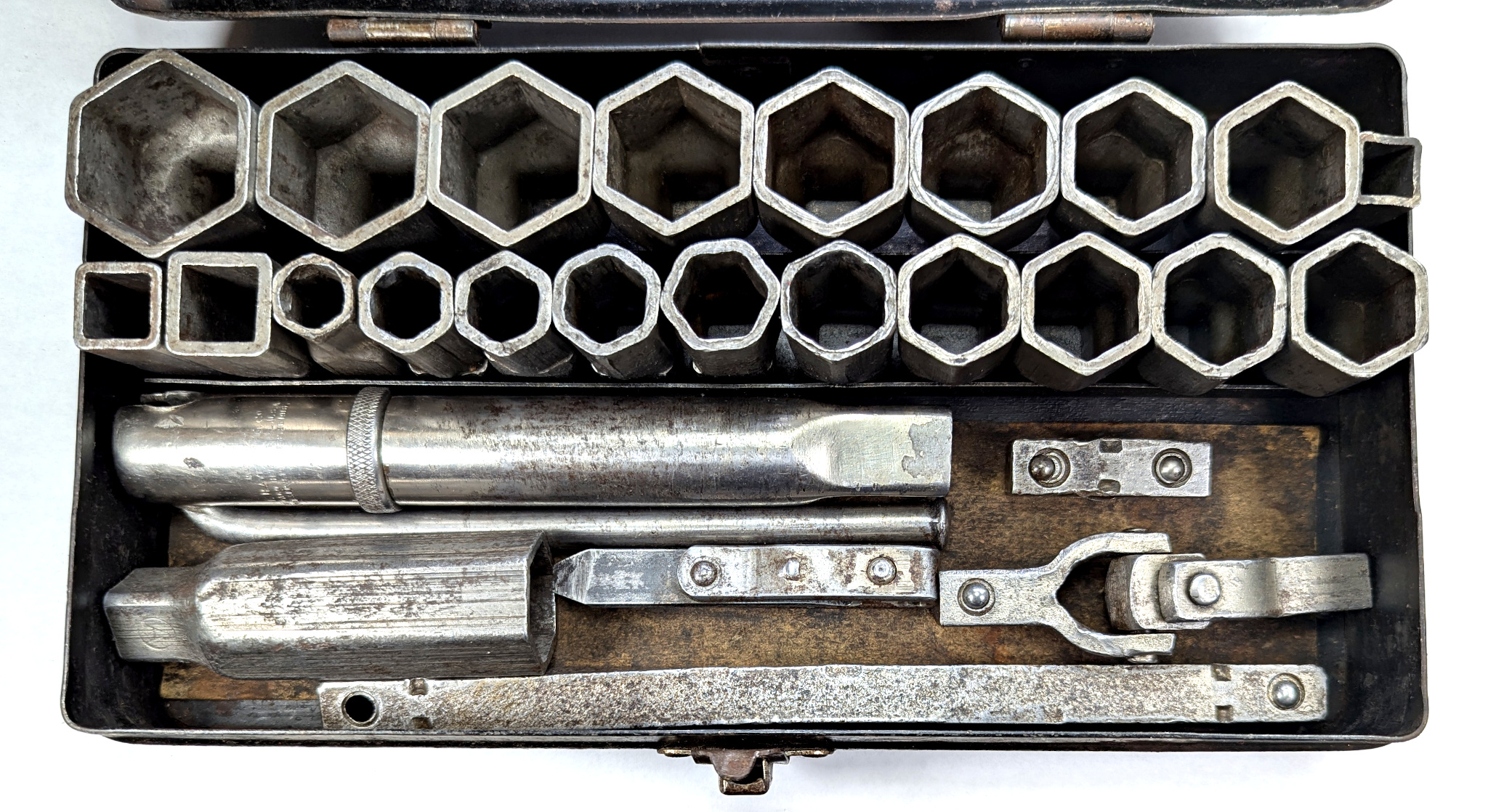
Fig. 4 shows
the Ayer "No. 22" pressed-steel socket set in its metal case,
consisting of a tubular reversible ratchet handle, a drive plug, an extension, a universal, a screwdriver attachment,
18 hexagon sockets, three square sockets, and a 29/32 spark plug socket.
The set as acquired was missing the drive plug and a 13/32 square socket,
and in addition the 21/32 square socket had been replaced by a 19/32 square socket,
a size needed for some Ford service tasks.
For the photo we borrowed the drive plug from another Ayer set
and the 13/32 square socket (seen at the far right in the back row) from a Ray set.
(The 13/32 square socket was squeezed into the back row so that the socket layout would match the
catalog illustration
for the Ray No. 22 set.)
The hexagon socket sizes are 15/32, 1/2, 17/32, 19/32, 5/8, 21/32, 23/32, 25/32, 13/16, 27/32, 7/8, 29/32, 31/32,
1 inch, 1-1/32, 1-3/32, 1-5/32, and 1-9/32.
The square socket sizes were originally 13/32, 17/32, and 21/32,
but the 21/32 socket had been replaced with a 19/32 socket.
All except one sockets were stamped with the fractional size,
and most of the sockets are also stamped with the Ayer
A-Circle logo,
with one stamped "RAY" and six with no additional marking.
The 18 hexagon sockets found in the Ayer set match the list of sizes given in a 1920 catalog for
an apparently earlier Ray No. 22 set,
except for the absence of the 11/16 socket.
(As can be seen from the photo,
even without the 13/32 square socket there would be no space to insert an 11/16 socket.)
The Ayer set thus provides evidence that the 11/16 socket was removed from the specification for later No. 22 sets.
Metal Case from Ayer "No. 22" Set
The set was furnished in a clam-shell case with construction closely resembling that used by
Packer Auto Specialty for their Ray socket sets.
In particular, the top is a one-piece pressing,
but the bottom of the case has a composite construction with wrap-around side walls and a riveted bottom plate.
The top is attached to the side walls of the bottom with riveted hinges,
and two socket trays are attached to the bottom plate using bent-over tabs.
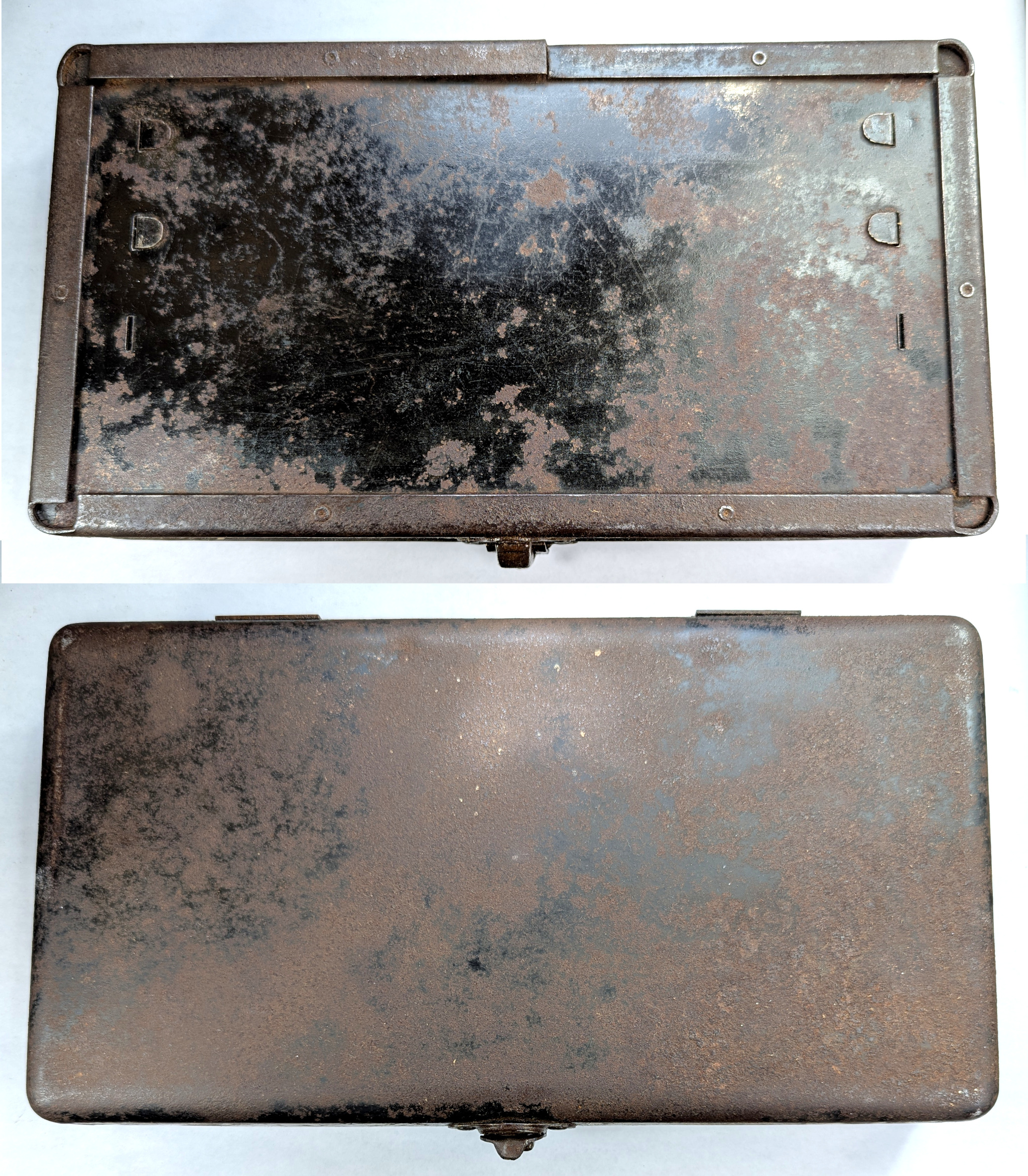
Fig. 4A shows
the unmarked metal case for the Ayer "No. 22" socket set.
The inset shows a bottom view of the case to illustrate the construction techniques.
The side rails have been formed from a continuous strip of metal overlapping at the back of the case,
with the flanges trimmed back for the folded corners.
Note that the bottom plate has been riveted to the flanges of the side rails,
with one rivet on the each of the short sides and two on the long sides.
Also note the folded-over tabs that secure the socket rails inside the case,
with two extra slots in case an additional rail was to be installed.
The dimensions are 10.8 inches long by 5.8 inches wide (exclusive of clasp and hinges) by 2.2 inches high.
The finish is black enamel,
with extensive losses due to rust,
especially on the top.
Inner Bay of Case from Ayer "No. 22" Set
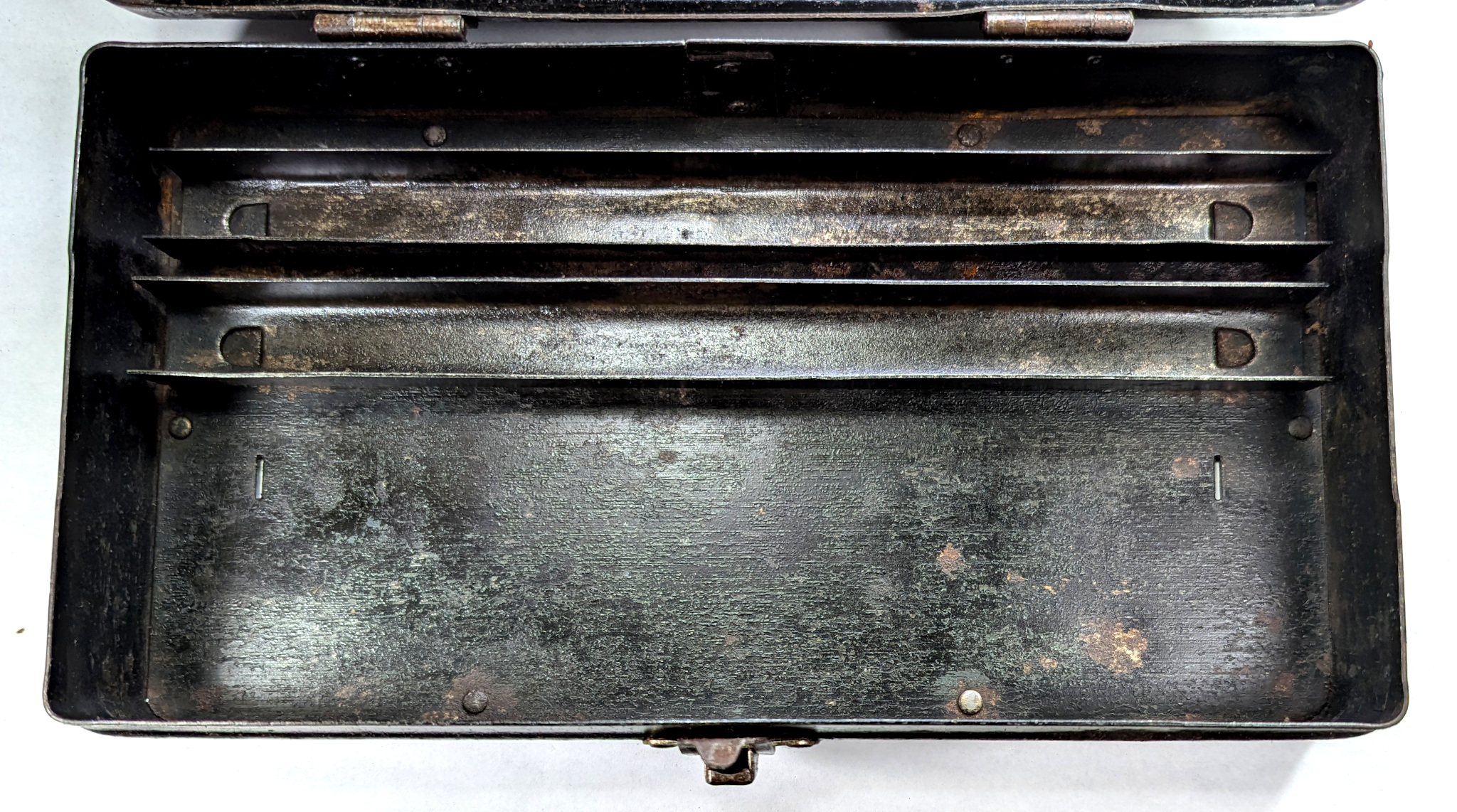
Fig. 4B shows
the inner bay of the case for the Ayer "No. 22" socket set.
The case has been furnished with two socket rails,
which have been secured to the bottom plate with tabs folded over on the back side.
The two extra slots in the bottom plate would allow an additional rail to be installed.
Note that the bottom plate has been riveted to the flanges of the side rails,
with the heads of the rivets visible along the sides.
Ayer 1/2-Drive Double-Ended Screwdriver Attachment from "No. 22" Set
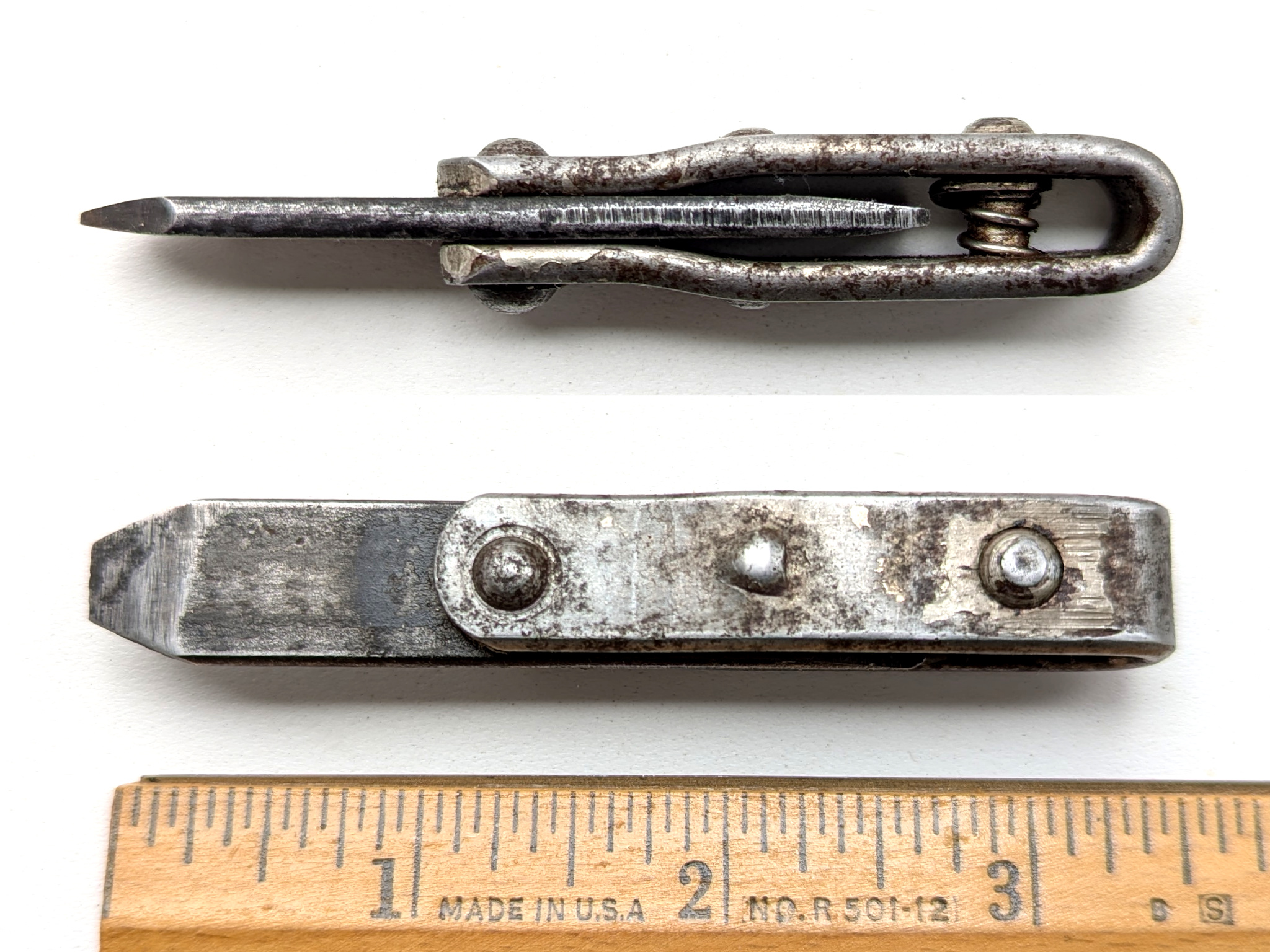
Fig. 4C shows
the unmarked 1/2-drive double-ended screwdriver attachment from the Ayer "No. 22" set.
The inset shows a side view of the tool,
illustrating the rotating screwdriver blade and the spring-loaded stud in the holder.
The overall length is 3.5 inches,
and the finish is nickel plating.
Screwdriver attachments were not common components of socket sets in the years before 1920,
and Ayer (and Ray) were one of the first companies to provide a tool like this.
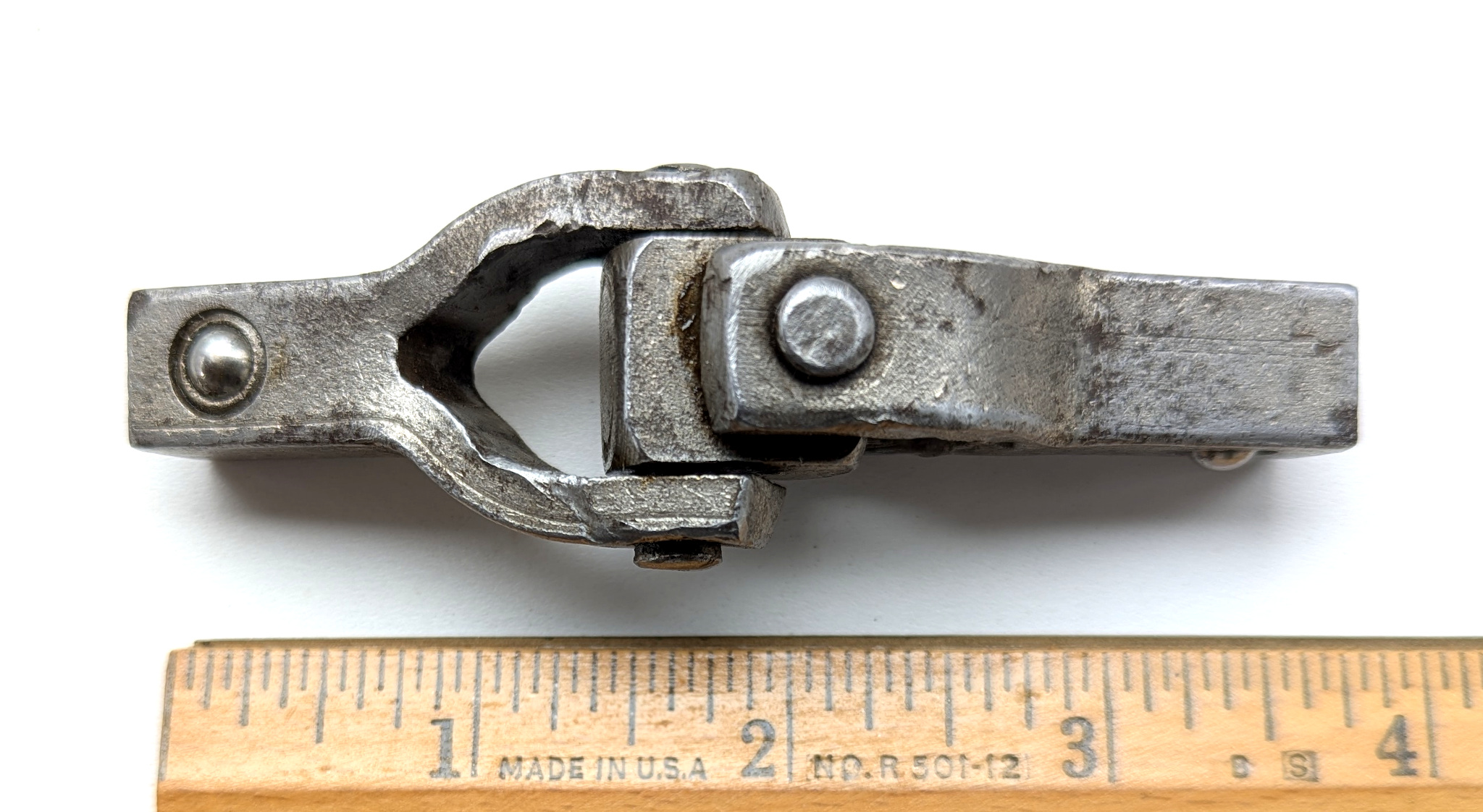
Ayer 1/2-Drive Universal from "No. 22" Set
Fig. 4D shows
the unmarked 1/2-drive universal from the Ayer "No. 22" set.
The overall length is 3.6 inches,
and the finish is nickel plating.
Each arm of the tool has been formed from a piece of solid 1/2 inch bar stock,
which was then split to form the yoke.
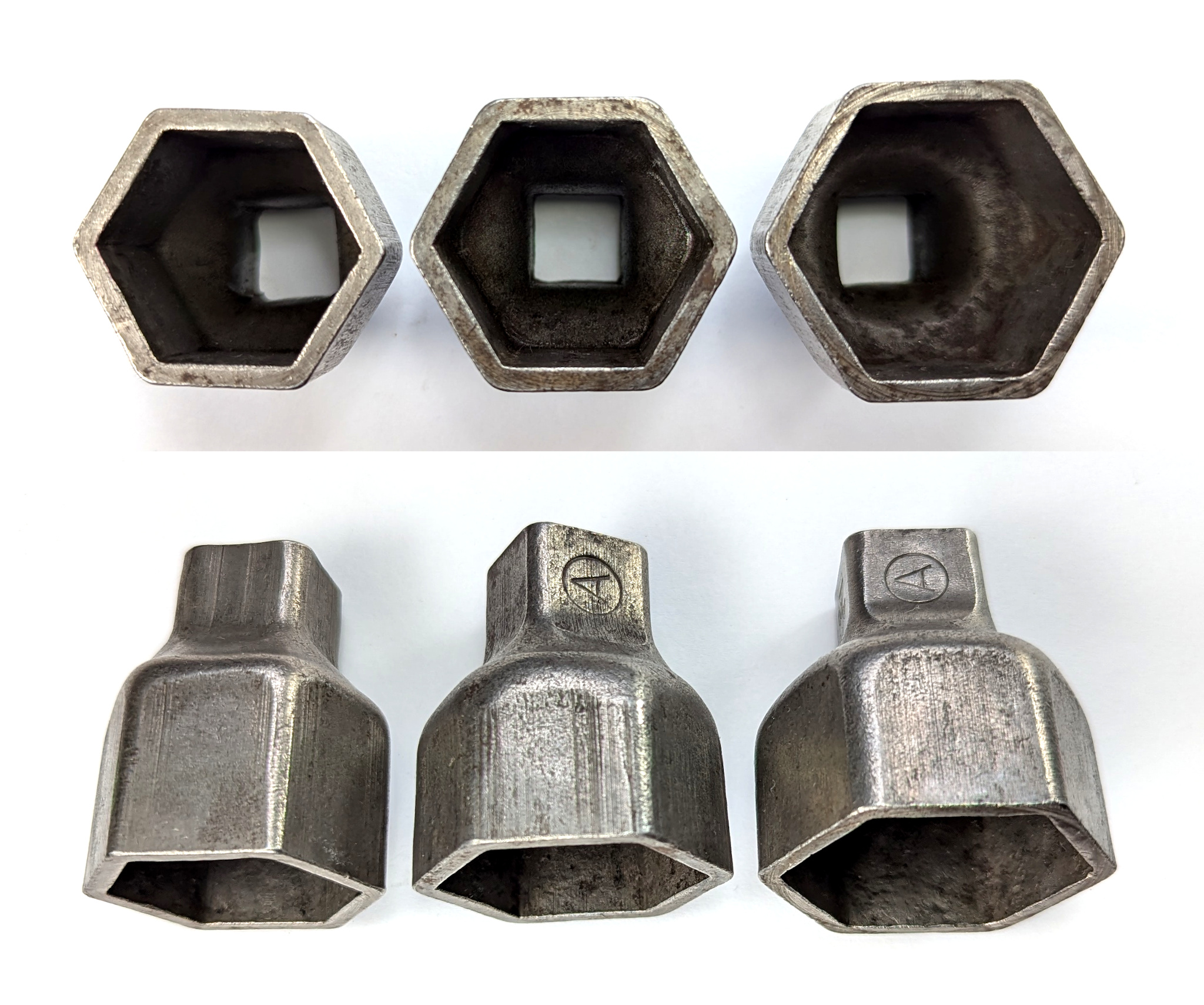
Ayer Large Hexagonal Pressed-Steel Sockets from "No. 22" Set
Fig. 4E shows
the three largest hexagonal pressed-steel sockets from the Ayer "No. 22" set.
The socket sizes are, from the left, 1-3/32, 1-5/32, and 1-9/32.
The sockets are all stamped with the fractional sizes,
and the sockets at the center and right are stamped with the Ayer
A-Circle logo.
The finish is plain steel.
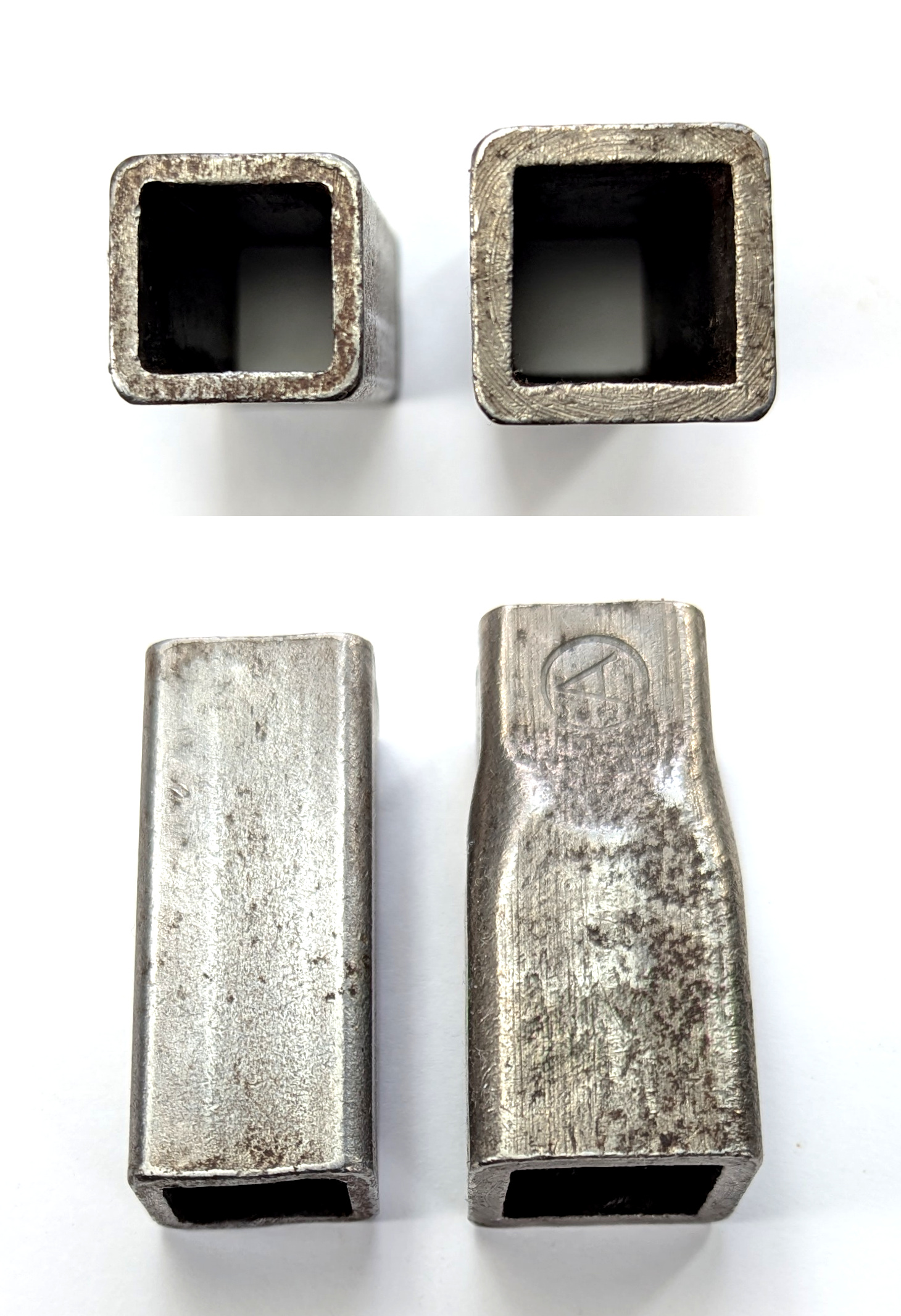
Ayer Square Pressed-Steel Sockets from "No. 22" Set
Fig. 4F shows
the two square pressed-steel sockets acquired with the Ayer "No. 22" set.
The socket sizes are, from the left, 17/32 and 19/32.
The left socket has no markings,
but the right socket is stamped with the 19/32 fractional size and the Ayer
A-Circle logo.
The finish is plain steel.
The 17/32 socket served two roles in the set,
first and obviously for handling 1/2 inch nuts or bolts (remember that pressed steel sockets are 1/32 oversize),
and secondly as a union to join the 1/2-drive tools when needed.
For example, to use the universal with the extension,
the two tools would be coupled together using the 17/32 square socket.
The 19/32 square socket was needed for certain Ford service tasks.
The set would have been originally furnished with three square sockets with sizes 13/32, 17/32, and 21/32.
Ayer Spark Plug Socket from "No. 22" Set
Fig. 4G shows
the 29/32 spark plug socket from the Ayer 26-piece set.
The socket is stamped with the fractional size and the Ayer
A-Circle logo.
The overall length is 3.6 inches,
and the finish is plain steel.
Ayer 1/2-Drive Tubular Tee-Handle Ratchet
Fig. 5 shows
an Ayer 1/2-drive Tee-handle ratchet with a tubular body,
stamped "F.H. Ayer Mfg. Co." and "Chicago Heights, Ill. U.S.A." on the upper body.
The ratchet is also marked with the "Pat. Sep. 9, 1913 Sep. 26, 1916" patent dates.
The overall length is 7.0 inches,
and the finish is nickel plating.
The first date refers to patent
1,072,807,
filed by F.H. Ayer in 1912 and issued in 1913.
The second date corresponds to two similar patents
1,199,737 and
1,199,738,
both filed by F.H. Ayer on December 23, 1915 and issued on the stated date in 1916.
Note that the drive end of the body has been swaged down to form a 1/2 inch square opening.
Although pressed-steel sockets were not usually described as having 1/2-drive,
the inner opening of the drive end had been a 1/2 inch square since the earliest Mossberg sets.
This ratchet model was typically supplied with pressed-steel socket sets
along with a 1/2-square drive stud, an extension, and a universal joint.
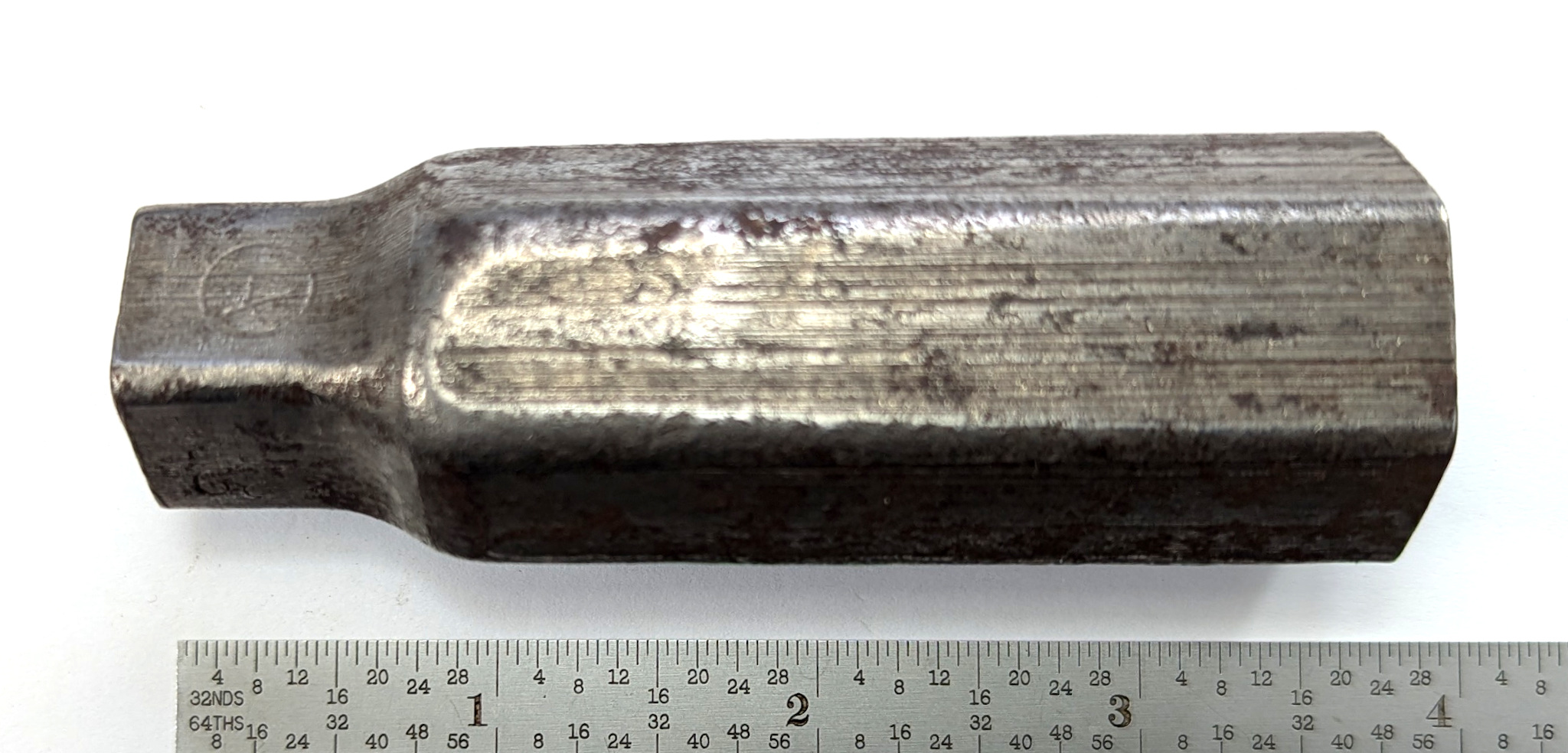
Ayer 1-9/32 Pressed-Steel Socket
This next figure shows an example of an Ayer pressed-steel socket,
taken from one of their socket sets.
Ayer sockets were generally driven from the 1/2 square inside opening.
Fig. 6 shows
a 1/2-drive Ayer 1-9/32 pressed-steel socket,
stamped with the
A-Circle logo
and the fractional size (not shown).
The finish is plain steel.
The F.H. Ayer pressed-steel sockets were interchangeable with those supplied by the Frank Mossberg Company,
the leading maker of pressed-steel socket sets.
Ayer sockets were also compatible with "Ray" brand sockets from the Packer Auto Specialty Company,
another Chicago-area maker of socket sets.
Given the proximity of the Ayer and Packer companies,
the socket sets from either company may be found with sockets or tools
from the other maker included.