The Story of Vlchek
![[Vlchek Logo on Open-End Wrench]](Photos/tools/vlchek_wrench_logo.jpg)
Vlchek Logo on an Open-End Wrench
| Alloy Artifacts |
The Vlchek Tool Company (pronounced "Vel-check") started as a small blacksmith shop and grew to become the largest maker of automobile tool kits. Founded by a Czech immigrant, the company built a reputation for high-quality tools as well as efficient production. In this page we'll look at the company's interesting history and examine a selection of its tools.
It's sometimes difficult to find information on the early history of tool companies, but the present case is a happy exception. The founder of Vlchek Tool was thoughtful enough to write his autobiography, suitably titled The Story of My Life and published (in Czech) in 1928. Now available in English translation, the book offers an interesting look at immigrant life in late 19th and early 20th century America, and provides many details on the development of the Vlchek Tool Company.
Vlchek Tool began in 1895 as a small blacksmith shop founded by Frank J. Vlchek, a Czech immigrant who had settled in Cleveland, Ohio. For the first few years his business operated as a typical blacksmith shop of the time — making and repairing metal items, sharpening tools, and even shoeing horses. But Vlchek was constantly pushing himself to improve his skills and learn new techniques, and this lead to the purchase of a power hammer and then a drop forge. Both tools were powered by an old gasoline engine he had purchased inexpensively and then rebuilt by hand.
The power hammer enabled Vlchek to improve both the production rate and quality of his tools, and the business expanded rapidly. By 1903 the operation had outgrown its original quarters, so Vlchek built a new larger shop at 1537 Central Avenue, with a sign proclaiming "The Vlchek Tool Manuf'g Co." on the front. As the business grew, Vlchek started selling hammers, chisels, and punches into the wholesale market, and soon raised the notice (and ire) of some long-established hardware makers.
On Feb. 24, 1909 a fire destroyed much of the new building, and this disaster threatened to close the business permanently. By this time though, Vlchek had established an excellent reputation for hard work and quality products, and so was able to gain the financial backing to set up a new operation.
Vlchek and a group of investors formed the Vlchek Tool Corporation, with Frank Vlchek as President and major shareholder, but answerable now to a board of directors. The company built a new factory on East 87th Street and was back in business by May of 1909.
The new company prospered and continued to expand, chiefly due to the rapid growth of the automobile industry.
Vlchek had for some time been making automobile tool kits, the collections of essential tools that were shipped with every automobile of the day. Automobile companies ordered thousands of tool kits at a time, and at one point Vlchek Tool claimed to sell to 85 percent of the automobile makers. (There were many more auto companies in those days.)
Fig. 1 shows a notice for a Vlchek tool kit, as published on page 242 of the May, 1912 edition of The Automobile Trade Journal.
This particular example was intended as a motorcycle tool kit, and the text lists the contents as a monkey wrench, combination pliers, screw driver, flat file, drift punch, cold chisel, hammer, tire tools, and a box of cotter pins. The price was $3 in an imitation leather case, or $4 for genuine leather.
The tool kit business was profitable but challenging, as the automobile makers were constantly trying to reduce the price, and the production contracts specified large volumes and tight delivery schedules.
Vlchek responded by improving the production efficiency and material workflow of the factory, so that raw steel moved efficiently from the loading dock through the various forging and finishing steps. Visitors of the day (frequently including competitors) marveled at the smooth and efficient operations.
Vlchek was also a pioneer in cost analysis, and the company established a special Cost Department to keep up-to-date estimates of the costs of production. This move was prompted by Vlchek's observation that many of his competitors didn't know whether they were operating at a profit or loss until the books were closed at the end of the year. Obviously, this would have been a major problem in a period of fluctuating prices.
The combination of efficient production and good business management allowed Vlchek Tool to expand its factory several times between 1909 and 1920.
Fig. 2 shows an advertisement for a Vlchek valve lifter, as published on page 177 of the January, 1917 issue of Hardware Dealers' Magazine.
Although not noted in the text, this tool was covered by patent 1,159,626, issued to F.J. Vlchek in 1915.
Fig. 3 shows a notice of reorganization of the Vlchek Tool Company, as published on page 61 of the January, 1918 issue of Hardware Review.
The text notes that the company's capital had been increased from $300,000 to $900,000, a substantial sum in those days.
By 1918 Vlchek had become one of the "Big Nine" of the forging industry: nine companies who together accounted for nearly all of the drop-forged wrench production. These companies jointly signed a Conservation Agreement to reduce manpower and materials, as requested by the War Industries Board.
Vehicle tool kits continued to be an important product for Vlchek in the 1920s. By the mid 1920s Vlchek had begun placing ads in some of the popular magazines of the time, such as Popular Mechanics.
![[1924 Ad for Vlchek Tool Kits]](Photos/tools/scans/popular_mechanics_1924-12_p152_vlchek_tool_kits_cropped.jpg)
The scan in Fig. 4 shows an ad for Vlchek tool kits, as published on page 152 [External Link] of the December, 1924 issue of Popular Mechanics.
The illustration shows the 20-piece "Tourist" kit in a canvas roll, priced at $7. The text offers other tool kits ranging from the No. 909 "Little Roadster" at $3 up to the No. 900 "Mechanician Kit" at $20.
The tools in the illustration include open-end wrenches, an alligator wrench, combination pliers, screwdrivers, a bearing scraper, an auto wrench, and a ballpeen hammer. These tools could all be produced efficently by drop-forging, and Vlchek had optimized its operations for high-volume drop-forge production.
The text claims that the company was the world's largest producer of tool kits, and there can be little doubt of the accuracy of the claim.
![[1928 Notice for Vlchek Wrench Sets]](Photos/tools/scans/hardware_age_1928-07-19_p60_vlchek_wrench_cropped.jpg)
In 1928 Vlchek began offering open-end wrenches made of chrome-molybdenum alloy steel, generally regarded as one of the highest quality steels for tool making.
Fig. 5 shows a notice for Vlchek wrench sets in carbon steel and chrome-molybdenum steel, as published on page 60 [External Link] of the July 19, 1928 issue of Hardware Age.
The top illustration shows the "Fitz-All" carbon steel wrench set, and the bottom illustration shows the new chrome-molybdenum wrench set. Although not mentioned in the text, the wrenches were designed with "Parabolic" heads.
By this time open-end wrenches of chrome-vanadium or chrome-molybdenum steel had been available for several years from Bonney, J.H. Williams, and others, but sales were primarily to professional markets. Since Vlchek tools were widely sold in retail markets, the introduction of chrome-molybdenum alloy steel was significant.
Vlchek catalog No. 13 (undated, but from around 1928) offered a selection of open-end and tappet wrenches in chrome-molybdenum steel. The illustrations of wrench sets in the catalog match the illustrations at the left, so this published notice helps to establish the time frame for the catalog.
Catalog No. 13 used the "FITZ-ALL" brand for carbon steel wrench sets, and in early 1928 Vlchek applied for a trademark on "FITZ-ALL', with the first-use date in October of 1927. The timeline for the trademark also supports a 1928 publication date for the catalog.
The adoption of chrome-molybdenum steel signified that Vlchek tool was expanding beyond tool kits into general automotive service tools, and from the late 1920s onward the company offered wrenches, pliers, and striking tools in both carbon and alloy steels.
![[1929 Ad for Vlchek Tool]](Photos/tools/scans/hardware_age_1929-12-26_p10_vlchek_cropped.jpg)
By 1929 Vlchek was placing full-page ads for its wrench sets and tools.
Fig. 6 shows an ad for Vlchek wrenches and tools, as published on page 10 [External Link] of the December 26, 1929 issue of Hardware Age.
The illustration shows wrench sets in both carbon steel and chrome-molybdenum steel, a chisel and punch set, tappet wrenches, and a chrome-molybdenum brake adjusting wrench.
The text below the illustration of the tappet wrench set claims that these were the world's best selling tappet sets.
A full-page ad in the May 1930 issue of Popular Science Monthly shows an impressive Vlchek Forging Hammer along with examples of the various tools sold by the company. The text of the ad emphasizes the high quality of Vlchek tools and the low cost made possible by volume production.
In 1930 Vlchek introduced a line of screwdrivers with shock-proof molded plastic handles. The tools proved to be popular and Vlchek Tool became one of the largest makers of screwdrivers.
By 1934 Vlchek Tool had greatly expanded its offering of automotive service tools. Catalog A-2 from 1934 included sockets and drive tools in 1/2 and 3/4-drive, the first time that these important tools had been offered by the company. The catalog also listed box-end wrenches and a variety of automotive specialty tools.
Another notable change was that the catalog was now divided into two parts, with the first section captioned with the somewhat awkward "Quali-T-Tools" brand and apparently intended for the professional mechanic. The second section listed Vlchek's high-volume product lines intended more for occasional or casual use, but including some alloy steel tools as well.
For whatever reasons, Vlchek's venture into the full-service automotive market was short-lived, and by 1938 the product line had been reduced greatly. The socket tools had been discontinued, and the company apparently decided to concentrate on high-volume production items rather than specialty tools, so that its catalogs listed relatively few tools.
Vlchek's experience with plastic screwdriver handles resulted in the company becoming a pioneer in the field of injection-molding, and by 1938 Vlchek had formed a plastic injection-molding division.
By 1945 the plastics division had a separate facility in Middlefield, Ohio. (The Vlchek name is apparently still in use for some plastic floral containers.)
In the post-war years Vlchek continued production of its alloy steel wrench lines, and also offered a wide range of economy "special analysis" steel tools.
Except for a brief period in the mid 1930s, Vlchek Tool had ignored the socket revolution for most of its history, but in the mid to late 1950s began offering socket tools in 1/4, 3/8, 1/2, and 3/4-drive. However, these late socket tools were not produced internally, but were sourced as contract production from Plomb Tool/Pendleton Tool Industries.
In 1959 Vlchek Tool was acquired by Pendleton Tool Industries, the parent company of Proto Tools, P&C, Penens Corporation, and other tool manufacturers. (The acquisition date comes from a newpaper notice, noted in our article on Proto.) Under Pendleton the Vlchek brand remained in production, with the Vlchek factory continuing production of tools for the Vlchek brand, as well as contract production for Fleet Tools and possibly other Proto brands. In addition, other manufacturers in the Pendleton group contributed tools branded as Vlchek.
In 1964 Pendleton Tool Industries was acquired by Ingersoll-Rand, an industrial conglomerate. Under Ingersoll the Vlchek factory in Cleveland was finally closed in 1969, but it's not known whether the Vlchek brand continued in use after this.
| Patent No. | Inventor | Filed | Issued | Notes and Examples |
|---|---|---|---|---|
| 998,660 | F.J. Vlchek | 02/11/1911 | 07/25/1911 | Drill Press |
| 1,015,461 | F.J. Vlchek | 06/26/1911 | 01/23/1912 | Bearing Scraper
Bearing Scraper |
| 1,159,626 | F.J. Vlchek | 03/21/1914 | 11/09/1915 | Valve Spring Compressor
Valve Spring Compressor |
| 1,168,844 | J.J. Bartenstein | 05/31/1913 | 01/18/1916 | Adjustable Spanner Wrench
Adjustable Pin Spanner |
| 1,195,297 | F.J. Vlchek | 02/21/1916 | 08/22/1916 | Mortar Joint Scraper |
| 1,324,286 | F.J. Vlchek | 05/01/1918 | 12/09/1919 | Apparatus for Forming Dies |
| 1,508,489 | F.J. Vlchek | 07/08/1922 | 09/16/1924 | Ripping Bar |
| 1,808,190 | F.J. Vlchek | 12/10/1927 | 06/02/1931 | Wrench Set Holder
Norivell Wrench Set |
| 1,841,688 | F.J. Vlchek | 07/07/1930 | 01/19/1932 | Screwdriver |
| 1,877,466 | E.C. Koster | 06/29/1928 | 09/13/1932 | Wrench Set Holder |
| 1,868,476 | F.J. Vlchek | 03/30/1929 | 07/19/1932 | Drop Hammer |
| 1,954,157 | F.J. Vlchek | 08/22/1931 | 04/10/1934 | Drop Hammer |
| 1,956,885 | F.J. Vlchek | 12/22/1930 | 05/01/1934 | Drop Hammer |
| Text Mark or Logo | Reg. No. | First Use | Date Filed | Date Issued | Notes |
|---|---|---|---|---|---|
| SERVALL [logo] | 247,543 | 02/21/1928 | 04/09/1928 | 10/02/1928 | For tool sets with nail set and punches.
Serial 264,619. Published July 24, 1928. |
| FITZ ALL | 251,700 | 10/24/1927 | 01/23/1928 | 01/08/1929 | For wrenches and wrench sets.
Serial 260,542. Published January 8, 1929. |
 |
254,241 | 01/01/1910 | 01/03/1929 | 03/12/1929 | Underline logo.
Used for tools. |
| ALL PURPOSE | 254,256 | 01/16/1928 | 04/09/1928 | 03/12/1929 | Tool sets with hammer, pliers, and screwdriver.
Serial 264,618. Published March 12, 1929. |
| V.T.CO. | 256,629 | 01/01/1914 | 01/03/1929 | 05/21/1929 | Block text.
Hammers, chisels, punches, pliers, wrenches, other tools. Serial 277,563. Published March 12, 1929. |

|
256,630 | 01/01/1910 | 01/03/1929 | 05/21/1929 | "VTCo" in shield logo (V-Shield).
Hammers, chisels, punches, pliers, wrenches, other tools. Serial 277,564. Published March 12, 1929. |
| STAR | 256,631 | 01/03/1928 | 01/03/1929 | 05/21/1929 | Wrenches and wrench sets.
Serial 277,565. Published 03/12/1929. Renewed May 21, 1949. |
| LE GRAN | 256,632 | 06/01/1928 | 01/03/1929 | 05/21/1929 | Hammers, chisels, punches, pliers, wrenches, other tools.
Serial 277,566. Published March 12, 1929. |
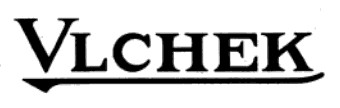
| VLCHEK | 528,105 | 01/01/1910 | 01/26/1949 | 07/25/1950 | |

|
532,854 | 05/03/1949 | 06/03/1949 | 10/31/1950 | Block text in slanted font.
Wrenches, chisels, and punches. |
Tools sold as Vlchek products are generally very easy to identify, as with few exceptions the company used only the markings "Vlchek" or "Motiv" for these items.
However, tools produced by Vlchek as contract production may be very challenging to identify.
Some contract production may have been intentionally unmarked at the request of the customer, in order not to reveal Vlchek as the actual producer. The high efficiency of the Vlchek factory gave them a much lower cost structure than many competitors, and in some cases erstwhile competitors gave up production in favor of purchasing goods from Vlchek and branding them as their own.
In other cases the contract customer may not have cared whether the tools were identifiable as Vlchek. For example, the Western Auto Supply buyers may have been happy to have customers recognize their Wizard and Westcraft wrenches as Vlchek tools. The examples in the section on Contract Production show that a number of such tools are easily identifiable as Vlchek production.
The sections below will present a number of design, production, and marking characteristics of Vlchek tools, and these characteristic features may be helpful for identification in the absence of an explicit company marking.
Although tools made for contract production may be difficult to identify, there is at least one simple case: some such tools were marked with the well-known V-Shield logo, a "V" and nested "T" inside a shield outline.
In 1929 Vlchek registered the V-Shield logo as a trademark, which was issued as #256,630 on May 21, 1929.
The scan in Fig. 7 shows the logo image as it was presented in the trademark application.
The small figure forged into tools is somewhat less detailed, but on a good forging the small "T" inside the "V" will be visible. An example of this logo on a tool can be seen in the Vlchek 19/32x11/16 Wrench in a later figure.
![[Coat-of-Arms Design]](Photos/tools/scans/vlchek_vtc_logo.jpg)
The V-Shield logo is based on a more complex "Coat-of-Arms" design, an example of which was published on the cover of the 1912 Vlchek catalog.
The scan in Fig. 8 shows the design on the 1912 catalog cover.
![[Banner Logo in 1934 Catalog]](Photos/tools/scans/vlchek_tool_cat_a-2_1934-04_p23_banner_logo_cropped.jpg)
By the late 1920s Vlchek had begun using a "banner" logo consisting of "VLCHEK" on a curved arc spanning a capital "V". This logo appears on the front cover and on most pages of Vlchek catalog No. 13 from around 1928, and also appears prominently on the front of a dealer's price list from 1931.
Fig. 9 shows the Vlchek "banner" logo in its catalog form, as published on page 23 of catalog A-2 from 1934. The banner logo in catalogs typically included the text "Guaranteed Tools" at the bottom.
![[Vlchek Banner Logo]](Photos/tools/vlchek_banner_logo.jpg)
The banner logo is more frequently found in catalogs than on tools, but some combination pliers and screwdrivers are known to have been marked with the logo.
Fig. 10 shows an example of a Vlchek "Banner" logo stamped on a tool. In this variant the design consists of a large "V" with a "Vlchek" banner crossing it, with "Made in U.S.A." at the top and bottom.
This example is from the Vlchek 8 Inch Combination Pliers shown in a later figure.
Earlier we said that Vlchek tools are generally easy to identify, but among the known exceptions are some carbon-steel wrench sets sold in a metal holder. These sets may have other brands marked on the holder, and sometimes there may be no company marking on the tools.
![[Vlchek Norivell Open-End Wrench Set]](Photos/tools/vlchek_norivell_oe_set_cropped.jpg)
Fig. 11 shows a "Norivell Wrench Set", which was identified as a Vlchek product by the patent #1,808,190 stamped on the bottom. (This patent was issued to F. Vlchek in 1931.)
The individual wrenches in the Norivell set are marked "Made in U.S.A." and "Drop Forged", but have no company or size markings.
The 1938 catalog shows an illustration for a set that looks very similar, but is shown as a "Checker Wrench Set". Both "Norivell" and "Checker" seem like a word play on "Velcheck", so that may be how the names were derived.
One of the characteristic features of Vlchek production is the frequent presence of a forged-in number on one end of a wrench, an example of which is shown in next figure. (Additional examples can be found in many of the figures in this article.)
The meaning of these forged-in numbers is not known, but they might indicate a particular drop-forge used in production, or possibly a generation number for the forging die. (Vlchek perfected a technique for forging its dies from a master copy, rather than having to make each by hand. This would have saved them a great deal of time and money for items made in sufficient quantity to wear out the forging die.)
Vlchek box-end wrenches typically included a forged-in mark resembling an asterisk, usually opposite the forged-in number on the back side. This detail is seldom (if ever) seen on other makers' tools.
![[Vlchek Asterisk Mark and Forged-In Number]](Photos/tools/vlchek_db1618_wbc1618_wrench_panel_f_cropped_inset.jpg)
Fig. 12 shows an example of the forged-in asterisk mark, as photographed on the shank of a WBC1618 box wrench.
The asterisk can be seen at the left of the raised panel.
Note also the forged-in number "18" at the left in the inset.
Another characteristic of Vlchek production is the use of a relatively sharp grinding radius on the box ends of wrenches.
![[Vlchek Wrench Box Ends]](Photos/tools/vlchek_heads_box_cropped.jpg)
Fig. 13 shows examples of the sharp grinding radius, as illustrated in a profile view of three stacked box-end wrenches.
Other manufacturers commonly provide ground and polished box ends on wrenches, but usually with a much larger radius of curvature.
Vlchek open-end wrenches also exhibit rounded edges on the wrench heads.
Vlchek frequently used chrome molybdenum alloys for its tools, and when the alloy content was marked on the tool, Vlchek commonly used a particular and distinctive marking style. The "Chrome Molybdenum" text was marked in a sans serif font using all capital letters, but with the leading "C" and "M" letters increased in height. Other makers typically used letters of uniform height for this type of marking.
![[Vlchek Chrome Molybdenum Marking]](Photos/tools/vlchek_oe2428_94_chrome_molybdenum_marking.jpg)
Fig. 14 shows an example of the Vlchek "Chrome Molybdenum" marking style, taken from a Vlchek 94 Tappet Wrench shown later in this article. Notice that the leading letters of the words are made taller, even though the letter forms are already capitalized.
Estimation of the manufacturing date for a tool is an important step in understanding its context within the overall output of the manufacturer. Vlchek is not known to have marked tools with a date code, so the estimation of production dates must be made based on factors such as design, markings, catalog listings, and other characteristics.
In this section we will offer guidelines for estimating the manufacturing dates of Vlchek tools.
The photographs and observations in these pages are based on items in the Alloy Artifacts collection.
Information on the early history of Vlchek Tool was obtained from Frank Vlchek's autobiography The Story of My Life, translation edited by Winston Chrislock and published by The Kent State University Press.
The Encyclopedia of Cleveland History has a brief article on the Vlchek Tool Company, which notes that Vlchek Tool was acquired by Pendleton Tool Industries. (The actual date of the acquisition was late 1959, rather than the 1958 date implied by the article.)
Product information was obtained from a number of Vlchek catalogs, as summarized in the table below.
A look at the 1938 catalog shows a reasonable line of carbon-steel open-end "engineers" wrenches, a smaller selection of alloy-steel open-end wrenches, a small number of box-end wrenches, and lots of punches, chisels, and hammers. Most notable is the absence of combination wrenches, already very popular at this time, and the lack of ratchets and sockets.
The 1952 catalog reveals a somewhat expanded product line that included more models of box-end wrenches, as well as (finally!) combination wrenches. In addition, a line of economy tools branded "Motiv" had been established. There were still no ratchets and sockets though, making it clear that Vlchek Tool had decided to sit out the socket revolution.
The 1957 catalog No. 10 finally offers a line of sockets and drive tools in several drive sizes. (However, these tools are not commonly found, so it appears that Vlchek may not have sold very many of them.) This catalog also shows a number of tool display boards intended to assist retailers, showing that the company was apparently shifting to serve the retail market, after selling primarily to large companies up to this point.
| Catalog | Date | Notes |
|---|---|---|
| No. 4 | 1912 | No copyright, dated 1912. 32 pages.
Fancy V-Shield logo on cover. Available for Download [External Link] from ITCL. Lists tool kits from 40-piece "Mechanician" kit to 8-piece motorcycle kit. Lists hammers, chisels, screwdrivers, bearing scrapers, and OE wrenches, noted as "Vlchek" brand. Lists combination pliers and auto wrenches, but without "Vlchek" brand. |
| No. 13 | 1928 | No copyright, undated.
Cover and interior pages display Vlchek "Banner" logo. Available for Download [External Link] from ITCL. Earliest Vlchek catalog to note use of chrome-molybdenum steel. Lists "Parabolic" open-end wrenches in carbon and Cr-Mo steel. Illustrates "FITZ-ALL" wrench sets in locking metal holder. Lists "Parabolic" tappet wrenches in Cr-Mo steel. Lists pliers in combination, universal, thin nose, and bent thin nose styles. |
| Price List | 1931 | No copyright, dated May 1, 1931. 16 pages.
Dealers' Price List. No illustrations. Available for Download [External Link] from ITCL. Lists 1xxx Cr-Mo "Parabolic" ISN open-end wrenches. Lists 2xxx Cr-Mo "Parathin" ISN open-end wrenches. |
| A-2 | 1934 | No copyright, dated April, 1934 on cover. List prices. 40 pages.
Available for Download [External Link] from ITCL. "Quali-T-Brand" section lists alloy steel tools. "Popular Priced" section lists carbon steel. Lists sockets and drive tools in 3/8, 1/2, and 3/4-drive, Cr-Mo steel. Lists W-series open-end wrenches, Cr-Mo steel. W-series open-end wrenches illustrated with wide shanks. Lists 29x-series tappet wrenches, Cr-Mo steel. Lists WBxx single-offset box wrenches, Cr-Mo steel. Lists WBxxxx short offset box wrenches, Cr-Mo steel. Lists WBLxxxx shallow offset box wrenches, Cr-Mo steel. WB and WBL series box wrenches illustrated with round shanks. Lists PF204, PF209, PFS209, and PA208 pliers, Cr-Mo steel. Lists "Quali-T-Brand" chisels and punches, Cr-V steel. Lists No. 2152 6-piece "Parabolic" Cr-Mo open-end wrench set. |
| A-4 | 1938 | No copyright, dated April, 1938. List prices. 31 pages.
Available for Download [External Link] from ITCL. Lists W-series Cr-Mo open-end wrenches. Lists 9x-series Cr-Mo tappet wrenches. Lists WBA-series Cr-Mo offset box wrenches with paneled shanks. Lists WBC-series Cr-Mo short box wrenches with paneled shanks. Lists WB-series alloy steel short offset box wrenches with round shanks. Lists PF204, PF209, and PA208 pliers in alloy steel. Some chisels and punches, Cr-V steel. Four pages of auto tool kits. No sockets or drive tools. No combination wrenches. |
| A-6 | 1949 | No copyright, dated July, 1949 on cover. 32 pages.
Available for Download [External Link] from ITCL. Lists W-series alloy steel open-end wrenches. W-series open-end wrenches illustrated with narrow shanks. Lists 9x-series Cr-Mo tappet wrenches. Lists WBA-series Cr-Mo offset box wrenches with flat shanks. Lists WBH-series alloy offset box wrenches with flat shanks. Lists WBC-series alloy short box wrenches with flat shanks. Lists WBE-series alloy combination wrenches with wide flat shanks. Lists standard combination pliers in 6 and 8 inch sizes, three finish options. No thin-nose or bent thin-nose pliers. Lists PFH309 Cr-Mo heavy-duty water-pump pliers. Chisels and punches in carbon steel only. |
| A-7 | 1952 | No copyright, dated July, 1952 on cover. 38 pages.
Came with Jobber's Price List J-1 dated July 20, 1953. Available for Download [External Link] from ITCL. Lists 9x-series Cr-Mo tappet wrenches. Lists WBA-series Cr-Mo offset box wrenches with flat shanks. Lists WBE-series alloy combination wrenches with wide flat shanks. Lists PFH309 Cr-Mo heavy-duty water-pump pliers. |
| A-9 | 1955 | No copyright, dated October, 1955 on cover. 44 pages.
Available for Download [External Link] from ITCL. No mention of chrome-molybdenum steel. Lists WBH-series offset box wrenches with flat shanks. Lists WBA-series offset box wrenches with flat shanks. Lists WBE-series combination wrenches, 14 sizes WBE12 to WBE40. WBE-series illustrated with wide flat shanks. Combination wrench sets illustrated with narrow shanks. Lists PHC208 hose-clamp pliers. Lists Crescent-style adjustable wrenches with square gullet. |
| No. 10 | 1957 | No copyright, dated October, 1957. 36 pages.
No mention of chrome-molybdenum steel. Lists WBE-series alloy combination wrenches with narrow shanks. Lists socket tools in 1/4, 3/8, 1/2, and 3/4-drive. Lists diagonal cutters and needlenose pliers. Lists PHC208 hose-clamp pliers. Lists Crescent-style adjustable wrenches. |
| No. 11 | 1959 | No copyright, dated April, 1959. 40 pages.
Available for Download [External Link] from ITCL. Introduces "Vega" line of drop-forged select steel tools. Lists "Vega" WO-series open-end wrenches. Lists "Vega" WC-series combination wrenches. Lists "Vega" WB-series angled box wrenches. |
Vlchek tools were sold through many different channels, including industrial distributors, automotive supply specialists, and even high-volume retailers such as Western Auto Supply.
In its earliest years (up to around 1909) Vlchek's main products were hammers, chisels, and punches, which were likely sold to the hardware and building trades.
With the introduction of the Model T Ford in 1909, the market for automotive service tools began growing rapidly, and Vlchek shifted its focus to automobile tool kits.
Catalog No. 4 from 1912 offered a wide selection of tool kits, which typically included tools such as open-end wrenches, screwdrivers, chisels, punches, pliers, a cotter-pin puller, a hammer, and an auto wrench. By 1912 Vlchek was producing most of these tools in-house, with the possible exception of the pliers and auto wrenches.
The examples of tools shown in the following sections are based on the capability of production, but the actual age of particular tools is generally not known. Vlchek is not known to have used a date code marking system and so it is often difficult to estimate the age of a tool.
Hammers (along with chisels and punches) were among the first tools produced by Vlchek Tool.
![[Vlchek 10 Inch Auto Hammer Ballpeen Hammer]](Photos/tools/vlchek_auto_hammer_10in_f_cropped_inset2.jpg)
Fig. 15 shows a Vlchek "Auto Hammer" 10 inch forged ballpeen hammer, marked with "The Vlchek Tool Co." forged into the handle, with "Auto Hammer" forged into the back side.
The overall length is 10.2 inches, and the finish is plain steel.
![[Vlchek Ballpeen Hammer]](Photos/tools/vlchek_ballpeen_hammer_cropped.jpg)
As a former blacksmith operation, you would expect Vlchek Tool to be an expert in hammers, and hammers were in fact one of their earliest products.
The hammer shown in Fig. 16 is a ballpeen model marked "Vlchek" and "Made in U.S.A.", and is probably from an automobile tool kit.
The length of the head is 3.8 inches; the handle had been shortened, so the original length is not known.
Chisels and punches were important products for Vlchek and the company produced large quantities of these tools throughout its history. Despite the extensive production, it's often difficult to find older examples of these tools, as the tools (especially chisels) may become worn from frequent resharpening and are eventually discarded.
![[Vlchek X872 1/8 Pin Punch]](Photos/tools/vlchek_punch_x872_cropped.jpg)
Fig. 17 shows a Vlchek [X872] standard 1/8 pin punch, stamped "Vlchek Standard" and "Made in U.S.A." on the square shank. The model number isn't marked on the tool, but the catalog identifies this as model X872.
The overall length is 5.0 inches.
![[Vlchek Standard 1/8 Tapered Punch]](Photos/tools/vlchek_p04_punch_taper_standard_paint_f_cropped_inset.jpg)
Fig. 18 shows a Vlchek standard 1/8 tapered punch, stamped "Vlchek Standard" and "Made in U.S.A." on the square shank.
The overall length is 7.9 inches, and the finish is gray paint.
![[Vlchek Standard 1/4 Tapered Punch]](Photos/tools/vlchek_p08_punch_taper_standard_12in_cadmium_f_cropped_inset.jpg)
Fig. 19 shows a Vlchek standard 1/4 tapered punch, stamped "Vlchek Standard" and "Made in U.S.A." on the square shank.
The overall length is 11.8 inches, and the finish is cadmium plating.
Screwdrivers were important components of tool kits and by 1912 Vlchek was offering both forged all-steel screwdrivers as well as conventional models with a forged shank and wooden handle.
![[Vlchek 9 Inch Forged Steel Screwdriver]](Photos/tools/vlchek_screwdriver_steel_vshield_f_cropped_inset.jpg)
Fig. 20 shows a Vlchek 9 inch forged steel screwdriver, marked only with the V-Shield logo forged into one of the handle flanges.
The overall length is 9.0 inches.
The finish is plain steel with traces of the original black paint.
![[Vlchek 10 Inch Forged Steel Screwdriver]](Photos/tools/vlchek_screwdriver_steel_cleve_f_cropped_inset.jpg)
Fig. 20B shows a Vlchek 10 inch forged steel screwdriver, stamped "Vlchek Clev'd, O." on the shank.
The overall length is 9.8 inches.
The finish is plain steel with traces of the original black paint.
![[Vlchek ND-32 1/2 Inch Nut Driver]](Photos/tools/vlchek_nd32_driver_cropped.jpg)
Fig. 21 shows a Vlchek ND-32 1/2 inch nut driver with a wooden handle, marked "U.S.A." on the shank.
The overall length is 8.9 inches.
The wooden handle is finished with black paint, and the shank and socket appear to be plated with nickel.
![[Vlchek No. 2 Adjustable Pin Spanner]](Photos/tools/vlchek_no2_adj_pin_spanner_pend_f_cropped_inset2.jpg)
Fig. 22 shows a Vlchek No. 2 adjustable pin spanner, marked with "The Vlchek Tool Co." forged into the shank, and with "Pat. App'd For" stamped into the spanner arm.
The back side is marked with "No. 2" forged into the shank, as shown in the middle inset.
The overall length ranges from 10.3 inches to 12.2 inches, and the finish is plain steel.
The patent pending status refers to patent #1,168,844, filed by J.J. Bartenstein in 1913 and issued in 1916, with assignment to the Vlchek Tool Company.
![[Vlchek Forged Valve Spring Lifter]](Photos/tools/vlchek_valve_spring_comp_cropped.jpg)
Fig. 23 shows a specialty tool for compressing valve springs, stamped "Vlchek Cleveland" on one arm.
The overall length is 10.2 inches, and the finish is black paint.
Although no patent notice is marked on this example, this tool is covered by patent #1,159,626, issued to F.J. Vlchek in 1915.
![[Vlchek No. 600 Fitz-All Valve Spring Lifter]](Photos/tools/vlchek_valve_spring_lifter_pend_f_cropped_inset.jpg)
Fig. 24 shows a later Vlchek [No. 600] "Fitz-All" valve spring lifter constructed of stamped sheet metal, marked with "Vlchek" and "Patent Pending" on the top.
Although not marked with a model number, this tool is listed as a No. 600 Fitz-All Valve Lifter in the No. 13 and A-2 catalogs.
The overall length is 10.0 inches, and the finish is cadmium plating.
The patent corresponding to the pending notice on this tool is not yet known.
![[Vlchek No. 51 1/2 Bent Tubular Socket Wrench]](Photos/tools/vlchek_51_wrench_cropped.jpg)
Fig. 25 shows a Vlchek No. 51 1/2 bent tubular socket wrench tool, bent to form an Ell-shape and marked "Vlchek Cleveland".
The hex openings at each end have the same size and were measured as 1/2 (or possibly 17/32) inch.
The overall length is 6.5 inches.
The wrench has a cross-bar hole for additional leverage. The construction is from seamless steel tubing, hardened after forging, and with a plain steel finish.
These wrenches were apparently made for early Ford applications. For example, an automotive supplies catalog from 1916 shows a set of five of these wrenches in a canvas roll, marked "Bent Socket Wrench Set for Ford".
![[Vlchek Cotter Pin Puller]](Photos/tools/vlchek_cotterpin_puller_cropped_inset.jpg)
Fig. 26 shows a specialty tool designed as a cotter-pin puller and as a small pry-bar, marked "Vlchek Cleve O." as shown in the inset.
The overall length is 5.8 inches.
The finish is plain steel, although it may have been painted black originally.
![[Vlchek Bearing Scraper]](Photos/tools/vlchek_bearing_scraper_cropped_inset.jpg)
Fig. 27 shows a Vlchek bearing scraper with a wooden handle, marked "Vlchek Clev'd, O." on the shank.
The overall length is 12.7 inches.
The finish was originally black paint, but most of the paint has now worn off.
Although not marked with a patent notice, this tool resembles the description in patent #1,015,461, issued to F.J. Vlchek in 1912.
![[Vlchek 5/8x11/16 Reverse Gear Wrench]](Photos/tools/vlchek_oe2022_wrench_reverse_gear_vshield_f_cropped.jpg)
Fig. 28 shows an early Vlchek 5/8x11/16 specialty open-end wrench.
The wrench is marked with the V-Shield logo and "Reverse Gear Wrench" forged into the shank.
The overall length is 8.6 inches, and the finish is plain steel.
This wrench was designed for adjusting the reverse gear (and brake) bands on the Model T Ford.
![[Vlchek 5/8x15/16 Spark Plug and Head Bolt Wrench]](Photos/tools/vlchek_so2030_wrench_sparkplug_plain_f_cropped_inset3.jpg)
Fig. 29 shows a popular tool for Model T Ford spark plug and head bolt service, a Vlchek 15/16 open-end and 5/8 hex socket wrench, stamped "Vlchek" on the face.
The overall length is 10.8 inches, and the finish is plain steel.
Similar wrenches were made by a number of other manufacturers, examples of which include the Herbrand 2334 Spark Plug Wrench and Herbrand 2335 Spark Plug Wrench.
![[Vlchek Hub Wrench]](Photos/tools/vlchek_hub_wrench_f_cropped.jpg)
Fig. 31 shows an early Vlchek hub wrench, marked only with the V-Shield logo. The hex opening was measured at 2-1/8 inches, and the open end is 1-7/16 inches.
The overall length is 8.7 inches. The original finish was black paint, but only a few traces remain now.
This next figure shows an example of the V-Shield logo on a Fordson socket wrench.
![[Vlchek 2372 Fordson Socket Wrench]](Photos/tools/vlchek_2372_wrench_socket_fordson_f_cropped_inset4.jpg)
Fig. 33 shows a Vlchek 2372 offset socket wrench made for Fordson tractors, stamped with the model number and V-Shield logo, with "Fordson" on the back side.
The unmarked hex socket openings were measured as 3/4 and 7/8, with a 1/32 oversize allowance.
The overall length is 11.5 inches, and the finish is plain steel.
Auto or "monkey" wrenches were one of the standard items in automobile tool kits. These wrenches were offered in the 1912 Vlchek catalog, but since it did not illustrate or mention the "Vlchek" brand, the tools were probably sourced from another company. Vlchek's own production of auto wrenches probably began sometime between 1912 and 1920.
Auto wrenches were produced in several sizes, with the 9 inch and 11 inch models being the most common, but other sizes may be seen as well.
![[Vlchek 11 Inch Auto Wrench]](Photos/tools/vlchek_11auto_wrench_adj_cropped_inset.jpg)
Fig. 34 shows an early example of the Vlchek 11 inch auto or monkey wrench.
The movable jaw is marked "Drop Forged" and "Cleve. O, U.S.A." with the Vlchek name in a fancy emblem (see inset), a mark often seen on earlier tools.
The handle has additional markings "Made in U.S.A." and "11 Auto" in forged raised letters.
The overall length is 11.0 inches, and the finish is black paint, the standard for tool kit items of this type.
![[Vlchek V-Shield 11 Inch Auto Wrench]](Photos/tools/vlchek_11auto_wrench_adj_vshield_f_cropped_inset.jpg)
Fig. 35 shows a similar Vlchek 11 inch auto wrench, marked "11-In-Auto" in forged raised letters, with the V-Shield logo on the back side.
The overall length is 11.0 inches, and the finish is black paint.
![[Vlchek V-Shield 9 Inch Auto Wrench]](Photos/tools/vlchek_9auto_adj_wrench_vshield_b_cropped_inset.jpg)
Fig. 36 shows one of the staples of an automobile tool kit, a Vlchek 9 inch auto wrench marked "9 In Auto" in raised letters.
The inset shows the V-Shield logo on the back side, near the fixed jaw of the wrench.
The overall length is 8.9 inches, and the finish is black paint.
The movable jaw of this relatively early model is a forging, the standard construction of the time. The next figure will show a later construction technique.
![[Vlchek V-Shield 9 Inch Auto Wrench]](Photos/tools/vlchek_9auto_adj_wrench_cropped_inset.jpg)
Fig. 37 shows a later version of the Vlchek 9 inch auto wrench, marked "Made in U.S.A." and "9 Auto" in raised letters, with the V-Shield logo and the number "25" on the back side.
The overall length is 8.9 inches, and the finish is plain steel.
In this later model, the movable jaw is now made with a piece of sheet steel riveted to the hardened jaw piece.
![[Vlchek V-Shield 14 Inch Auto Wrench]](Photos/tools/vlchek_auto_14in_wrench_vshield_f_cropped_inset.jpg)
Fig. 38 shows a Vlchek 14 inch auto wrench, marked with "14 In. Auto" forged into the shank, with the V-Shield logo forged into the back side (see inset).
The finish is black paint.
The overall length is 13.9 inches, and the maximum opening is about 4.0 inches.
![[Vlchek V-Shield 15 Inch Auto Wrench]](Photos/tools/vlchek_auto_15in_wrench_f_cropped_inset.jpg)
Fig. 39 shows a Vlchek 15 inch auto wrench, marked with "Drop Forged" and "Vlchek" stamped on the movable jaw, and with "Made in U.S.A." and "15 Auto" (partially obscured) forged into the shank.
The overall length is 15.0 inches, and the finish is plain steel.
The hole at the end of the shank is roughly made, possibly with a cutting torch, and was likely added by a former owner.
Vlchek had a long history of producing combination pliers, as these tools were an important part of most automotive tool kits. The 1912 catalog offered combination pliers in a 6 inch size, but since it did not illustrate or mention the "Vlchek" brand, the tools were probably sourced from another maker. Vlchek's own production of pliers probably began sometime between 1912 and 1920.
Pliers made for tool kits were generally only roughly finished, as the unit cost needed to be kept low, and typically were offered only in a 6 inch size.
![[1928 Notice for Vlchek Combination Pliers]](Photos/tools/scans/motor_record_1928-01_p90_vlchek_tool_cropped.jpg)
By the late 1920s Vlchek was offering combination pliers in its catalogs in a range of sizes and styles. In addition to the expanded selection, these pliers were available in more refined finishes including polished nickel, and the higher grade models were made with patterned ("knurled") handles.
Fig. 40 shows a notice for Vlchek combination pliers, as published on page 90 [External Link] of the January, 1928 issue of Motor Record. The text notes that the pliers were available in sizes 5, 6, 8, and 10 inches.
Note that the illustration shows the pliers with simple bow-shaped handles. Although not shown in the illustration, some models were supplied with patterned handles.
Currently our earliest catalog reference to this expanded selection of pliers is the Vlchek catalog No. 13 from around 1928. This catalog lists combination pliers matching the above notice in sizes 5, 6, 8 and 10 inches, with three finish options, bright nickel (models PR30x), satin nickel (models PR40x), and black oil (models PR80x).
The PR30x and PR40x models were noted as having "knurled" handles, which based on observed examples was a rectangular grid pattern.
In addition to its standard combination pliers, catalog No. 13 offered thin combination pliers ("PS" prefix) in 5 and 6 inch sizes, bent thin combination pliers ("PB" prefix) in a 6 inch size, universal pliers ("PU" prefix) in a 7 inch size, and side-cutting combination pliers ("PC" prefix) in a 7 inch size.
The additional styles were also supplied with "knurled" handles, and with the exception of the thin pliers, all had bow-shaped handles. The thin pliers had "hand fitting" handles with convex and concave curves, a design that would later become standard for most Vlchek pliers.
Catalog No. 13 also offered "Multigrip" waterpump pliers ("PM" prefix) in a 9.5 inch size, with the description noting the use of chrome-alloy steel. Multigrip pliers were also available in a miniature 4.5 inch size for ignition work.
The illustrations in catalog No. 13 show the Vlchek "Banner" logo on all pliers, except for the case of the black oil finish, for which no markings are visible. The Banner logo is believed to have originated around this time, and every page of the catalog shows the Banner logo at the bottom.
By 1938 (Vlchek catalog A-4) the selection of pliers and the available finish options had been significantly reduced. The universal and side-cutting combination pliers had been discontinued, and the finely finished patterned ("knurled") handles were no longer offered.
Combination pliers had been standardized into three model series: PR30x with a bright nickel finish, PR20x with a cadmium or "Velco" finish, and PR90x with a natural black finish. In addition, the more popular 6 and 8 inch sizes were now made with "hand fitting" (convex and concave) handles instead of the previous bow-shaped handles.
Pliers in the 30x series (higher-grade finish) were made with a bolt and nut securing the slip-joint connection, whereas the two lower finish grades had a riveted connection. Riveted connections had been offered in the 1928 catalog as a cost saving option for pliers with the black oil finish, but by 1938 had become standard for the lower grade finishes.
![[1952 Catalog Listing for Vlchek Pliers]](Photos/tools/scans/vlchek_cat_a7_1952_p29_pliers_cropped.jpg)
By 1949 (Vlchek catalog A-6) the selection of pliers had been further reduced. The thin-nose and bent thin-nose combination pliers had been discontinued, and standard combination pliers were available only in 6 and 8 inch sizes, with three finish options.
Three other types of pliers were offered: heavy-duty utility pliers in chrome-moly steel, water pump pliers in carbon steel, and slip-joint battery pliers.
The 1952 catalog showed that same lineup of pliers as the 1949 catalog, as can be seen in the catalog excerpt at the left.
Fig. 41AA shows the pliers offered by Vlchek in 1952, as published on page 29 of catalog A-7 from 1952.
The selection in the 1952 catalog continued with only minor changes through the end of the 1950s.
After the 1959 acquisition of Vlchek by Pendleton Tool Industries, production of Vlchek-branded pliers was transitioned to J.P. Danielson, the division of Pendleton responsible for pliers and adjustable wrenches.
![[Vlchek PR406 6 Inch Combination Pliers with Bow Handles]](Photos/tools/vlchek_pliers_6in_combo_banner_pattern_f_cropped_inset2.jpg)
Fig. 41A shows a pair of Vlchek 6 inch combination pliers with bow-shaped handles, stamped with the Vlchek "Banner" logo near the pivot.
The pliers are also marked with "Made in U.S.A." and a "28" code forged into the handles.
The top inset shows a side view of the pliers, illustrating the rectangular grid gripping pattern on the handles.
The overall length is 6.5 inches, and the finish is cadmium plating.
The gripping pattern can be described as a series of uniformly spaced horizontal ridges cut by bands of four vertical ridges, which form a rectangular grid of dots at the intersections. The pattern is similar in some respects to the well-known Crescent "Checkerdot" gripping pattern, an example of which can be seen on the Crescent L26 Pliers.
Note that the handles of these pliers are secured with a bolt and nut. By the late 1930s the less-expensive Vlchek pliers were being fitted with a permanent rivet instead of a bolt and nut.
Currently we don't have an exact catalog reference for these pliers, but the closest match would be the model PR406 pliers listed in the 1934 catalog A-2. This catalog illustrates the pliers with bow handles and the "Banner" logo, and the description mentions knurled handles, presumably the pattern shown here. However, the finish is stated as satin nickel instead of the cadmium plating observed on this example.
![[Vlchek PR308 8 Inch Combination Pliers]](Photos/tools/vlchek_pliers_8in_combo_banner_f_cropped_inset2.jpg)
Fig. 41B shows a pair of Vlchek 8 inch combination pliers, stamped with "Vlchek" and "Made in U.S.A." in the "Banner" logo on the handle, with "Forged in U.S.A." forged into the handles.
The handles also have forged-in codes "19" and "18" (not shown).
The overall length is 8.0 inches, and the finish is chrome plating.
These pliers have the "hand fitting" shape that became standard for most models from 1938 onward. Note that the pliers are secured with a bolt and nut, indicating that these would have been a higher cost model.
Although not marked with a model number, the bolt-and-nut connection and chrome plated finish indicate that these are model PR308 pliers.
The chrome finish suggests production in the 1950s.
![[Vlchek PR206 6 Inch Combination Pliers]](Photos/tools/vlchek_pliers_combo_6in_vshield_f_cropped_inset.jpg)
Fig. 42 shows a later pair of Vlchek 6 inch combination pliers, marked with "Forged in U.S.A." forged into the handles, and with the V-Shield logo stamped on the handles.
The top inset shows a side view of the pliers. Note the fairly rough finish of the pliers, with remnants of the trimming operation visible on the handles.
The overall length is 6.4 inches. The pliers have a plated finish, possibly nickel or chrome, but without a high polish.
Note that the pliers are secured with a permanent rivet rather than a bolt and nut. The plated finish and riveted connection indicate that these would have been model PR206 pliers.
The 1959 catalog noted the PR206 pliers with a "plated" finish, without specifying the type of plating. Earlier catalogs had specified a "Velco" finish, which historically had meant cadmium.
![[Vlchek PHC208 8 Inch Hose-Clamp Pliers]](Photos/tools/vlchek_phc208_pliers_cropped.jpg)
Fig. 43 shows the Vlchek model PHC208 8 inch hose clamp pliers, stamped with "Hose Clamp" and the model number near the pivot.
The pliers are also marked with "Forged in U.S.A." and an "18" code forged into the handles.
The finish appears to be cadmium plating over the rough forged steel.
The PHC208 hose-clamp pliers were first listed in Vlchek catalog A-9 from 1955.
![[Vlchek PFH309 10 Inch Heavy-Duty Waterpump Pliers]](Photos/tools/vlchek_waterpump_pliers_cropped.jpg)
Fig. 44 shows a pair of Vlchek [PFH309] 10 inch waterpump pliers, stamped "Vlchek Made in U.S.A." on one handle with "Alloy Steel" on the other.
The overall length is 9.5 inches, and the finish is plain steel.
Although not marked on this example, the PFH309 model number was identified by the 1952 catalog, where this model is listed as the "Heavy Duty Utility and Pump Pliers". The catalog listing noted the use of chrome molybdenum steel and a chrome plated finish.
The alloy steel marking and plain finish of this example suggest production during the 1942-1945 wartime years.
By 1912 Vlchek was producing open-end wrenches for its automobile tool kits.
Vlchek wrenches were made exclusively of carbon steel until the late 1920s, and after the introduction of alloy steels, Vlchek continued to produce carbon steel wrenches at least into the 1950s.
The earlier carbon-steel wrenches were frequently marked with a forged-in V-Shield logo, particularly those made for contract production. Sometimes the markings also included an industry-standard model number, or the least the opening sizes, but wrenches devoid of other markings are not unknown.
![[Vlchek 727 9/16x5/8 Open-End Wrench]](Photos/tools/vlchek_oe1820_v_shield_f_cropped_inset.jpg)
Fig. 45 shows a 9/16x5/8 open-end wrench marked with the V-Shield and "Made in U.S.A." forged into the shank, with "Drop Forged" forged into the back side.
The shank is also marked with a forged-in number "95" visible at the right.
The overall length is 6.1 inches.
The wrench is not marked with the sizes, but was measured as 9/16x5/8 inches, a model 727 wrench in the industry-standard notation. (See our table of Industry-Standard Numbers for Open-End Wrenches for more information.)
![[Vlchek V-Shield 27 19/32x11/16 Open-End Wrench]](Photos/tools/vlchek_oe1922_v_shield_cropped.jpg)
Fig. 46 shows a wrench marked only with the V-Shield logo, without even the sizes marked.
The sizes were measured as 19/32 by 11/16 inches, making it a model 27 by the industry standard.
The overall length is 5.8 inches.
This wrench may have been part of a tool kit, as the body appears to have traces of black paint remaining.
![[Vlchek 21 5/16x13/32 Open-End Wrench]](Photos/tools/vlchek_oe1013_21_wrench_f_cropped.jpg)
Fig. 47 shows a Vlchek 21 5/16x13/32 open-end wrench, stamped with the Vlchek name on the face.
The overall length is 3.7 inches, and the finish is plain steel.
The next two figures show examples of the Vlchek 729 wrench.
![[Vlchek 729 5/8x3/4 Open-End Wrench]](Photos/tools/vlchek_oe2024_729_wrench_plain_f2_cropped.jpg)
Fig. 48 shows a Vlchek 729 5/8x3/4 open-end wrench, stamped with the Vlchek name and model number on the faces.
The overall length is 7.1 inches, and the finish is plain steel.
![[Vlchek 729 5/8x3/4 Open-End Wrench]](Photos/tools/vlchek_oe2024_729_f_cropped_inset.jpg)
Fig. 49 shows another Vlchek 729 open-end wrench, stamped with the Vlchek name and model number on the faces, with "Made in U.S.A." and "Drop Forged" forged into the shank.
![[Vlchek 731A 3/4x7/8 Open-End Wrench]](Photos/tools/vlchek_oe2428_731a_wrench_plain_9_f2_cropped_inset.jpg)
Fig. 50 shows a Vlchek 731A 3/4x7/8 open-end wrench, stamped with "Vlchek" and the model number on the faces.
The shank is marked with "Made in U.S.A." and a "9" code forged into the front.
The shank is also marked with "Drop Forged" forged into the back, as seen in the inset, which has been rotated for readability.
The overall length is 8.2 inches, and the finish is plain steel.
Tools marked with the V-Shield logo were most commonly (double) open-end wrenches, but the next figure shows a less common single-open wrench.
![[Vlchek 909 1-1/8 Check-Nut Wrench]](Photos/tools/vlchek_oe36_v_shield_f_cropped_inset.jpg)
Fig. 50B shows a Vlchek 909 single-open wrench marked with the V-Shield logo.
The size is not marked but was measured as 1-1/8.
The overall length is 7.5 inches.
The wrench is fairly thin for its opening size, and may have been intended as a "check-nut" wrench, a wrench used to tighten a locking nut.
Open-end wrenches with an "S" shaped shank were a popular early wrench style, originally developed for use with square nuts. The "S" curve of the handle provides a natural 22.5 degree offset for the head, which allows the wrench to work with a minimal 45 degree swing clearance.
Vlchek offered S-shaped wrenches in a wide variety of sizes, ranging from a model 75-C (1/4x5/16) to 85-D (1-1/8x1-5/16) in a quasi-standard numbering system.
The next several figures show examples of "S" wrenches acquired as part of a Vlchek "Star" wrench set.
![[Vlchek 75B 3/8x7/16 S-Shaped Open-End Wrench]](Photos/tools/vlchek_oe1214_75b_wrench_s_star_f_cropped_inset.jpg)
Fig. 51 shows a Vlchek 75B 3/8x7/16 S-shaped open-end wrench, marked "Made in U.S.A." with "Drop Forged" on the back side. A forged-in number "4" appears on the shank at the right, and the fractional sizes are also forged into the back side.
The overall length is 6.2 inches, and the finish is plain steel.
This wrench was part of the "Star" five-piece wrench set in a metal holder, shown as the Vlchek "Star" Set in a later figure. As was common for wrenches sold in sets, the individual wrenches are not marked with the company name.
![[Vlchek 79 5/8x11/16 S-Shaped Open-End Wrench]](Photos/tools/vlchek_oe2022_79_wrench_s_star_f_cropped_inset.jpg)
Fig. 52 shows a Vlchek 5/8x11/16 open-end S-shaped wrench with the industry-standard number 79, marked "Made in U.S.A." with "Drop Forged" on the back side.
A forged-in number "6" appears on the shank at the right, and the fractional sizes are forged into the back side.
The overall length is 8.3 inches, and the finish is plain steel.
![[Vlchek 81B 3/4x13/16 S-Shaped Open-End Wrench]](Photos/tools/vlchek_oe2426_81b_wrench_s_star_f_cropped_inset.jpg)
Fig. 53 shows a Vlchek 3/4x13/16 open-end S-shaped wrench with the industry-standard number 81B, marked "Made in U.S.A." with "Drop Forged" on the back side.
A forged-in number "5" appears on the shank at the right, and the fractional sizes are forged into the back side.
The overall length is 9.3 inches, and the finish is plain steel.
![[Vlchek 83B 7/8x1 Open-End S-Shaped Wrench]](Photos/tools/vlchek_oe2832_83b_wrench_s_star_f_cropped_inset.jpg)
Fig. 54 shows the largest wrench from the "Star" set, a Vlchek 83B 7/8x1 S-shaped open-end wrench, marked with "Made in U.S.A." forged into the shank, with "Drop Forged" forged into the back side.
A forged-in number "5" appears on the shank at the right, and the fractional sizes are also forged into the back side.
The overall length is 10.3 inches, and the finish is plain steel.
A careful examination of the end faces shows that they are very flat but not ground, with the appearance of a rough forged surface pressed flat. This is likely the result of finishing using a "coining press", an operation using extreme pressure to produce tools with flat surfaces and tightly controlled thickness. The use of coining presses for tool making was one of the many production innovations introduced by Frank Vlchek.
Vlchek offered sets of wrenches in a bewildering array of size combinations and finish options, and under numerous brand names such as Fitz-All, Star, Norivell, and Checker. These sets were typically supplied in a metal holder made either of stamped sheet metal or with wire spring sides.
In order to clarify the contents of the various wrench sets, we have provided Table 4 below with a summary of the major set types.
In addition to these set types, each set could be purchased in up to five finish options. (The early 1930 catalog had four options, the 1934 catalog had five.)
For example, by the early 1930s the Large Fitz-All "6" Piece set could be ordered as a No. 2153 "Unfinished Tempered", No. 2150 "Ebony All Over", No. 2151 "Semi-Finished", No. 2405 "Velco Rust Proof, Cadmium Plated", or No. 2442 "White Nickel-Buffed Heads".
To provide one last twist, the catalogs note that for last two finish options the wrenches would be stamped with numbers and opening sizes. This implies that for the other finish options, the wrenches would be unmarked — a frequent observation for Vlchek wrench collectors.
| Wrench Set | Style | Pieces | Component Models and Sizes |
|---|---|---|---|
| Large Fitz-All "6" Piece | Open-End | 6 | Nos. 723, 725B, 27, 729, 31, and 33B
3/8x7/16, 1/2x9/16, 19/32x11/16, 5/8x3/4, 25/32x7/8, 13/16x15/16 |
| Junior Fitz-All "6" Piece | Open-End | 6 | Nos. 21, 723, 725B, 27, 729, and 31
5/16x13/32, 3/8x7/16, 1/2x9/16, 19/32x11/16, 5/8x3/4, 25/32x7/8 |
| Large Fitz-All "5" Piece | Open-End | 5 | Nos. 723, 725B, 27, 729, and 31
3/8x7/16, 1/2x9/16, 19/32x11/16, 5/8x3/4, 25/32x7/8 |
| Little Leader Fitz-All "5" Piece | Open-End | 5 | Nos. 21, 723, 725B, 27, and 729
5/16x13/32, 3/8x7/16, 1/2x9/16, 19/32x11/16, 5/8x3/4 |
| Star "S" Wrench | "S"-Shaped | 5 | Nos. 75-B, 77-B, 79, 81-B, and 83-B
3/8x7/16, 1/2x9/16, 5/8x11/16, 3/4x13/16, 7/8x1 |
We hope that the above table will assist wrench historians in documenting and restoring their Vlchek wrench sets. Of course, after eighty years in an unheated barn the five finish options are likely to have turned to rust, rust, rust, rust, and rust, but the presence of stamped model numbers and sizes will at least distinguish the last two from the first three.
We have several examples of Vlchek wrench sets and will add them to this section as time permits.
Fig. 55 shows a Vlchek "Norivell" open-end wrench set, marked with "Norivell Wrench Set" and "Drop Forged Tempered" embossed on the sheet metal holder, and with patent #1,808,190 stamped on the bottom. This patent was issued to F. Vlchek in 1931, allowing the set to be identified as Vlchek production.
The individual wrenches in the set are marked with "Made in U.S.A." and "Drop Forged" forged into the shank, but have no company or size markings.
![[Vlchek Star Five Piece S-Shaped Wrench Set]](Photos/tools/vlchek_oe_wrench_set_star_x5_f_cropped_expand_inset.jpg)
Fig. 56 shows a Vlchek "Star" S-shaped wrench set, consisting of five S-shaped wrenches in a wire spring holder.
The set is marked with "Star S Wrench Set" plus "The Vlchek Tool Co." and "Cleveland, O." stamped on the bottom of the holder (see inset).
The wrenches in the set are models 75B (3/8x7/16), 77B (1/2x9/16), 79 (5/8x11/16), 81B (3/4x13/16), and 83B (7/8x1 Inch).
Each wrench is marked with "Drop Forged" and "Made in U.S.A." forged into the shank, along with the sizes and model number.
The set as acquired was missing the 77B wrench, so we have substituted a model of the same size from another maker to fill out the holder for the photograph. (We later managed to find the proper Vlchek wrench to complete the set.)
The bottom of the holder is also stamped "U.S. Patent 1808190", a reference to patent #1,808,190, issued to F. Vlchek in 1931. Note that this is the same patent seen on the Norivell Wrench Set described previously. (The wrench holders don't look very much alike, but the patent was written to provide a lot of "wiggle room".)
The Vlchek catalog No. 13 from around 1928 offered the Star wrench sets in three finish options, at prices ranging from $1.55 to $2.00.
| Alloy Artifacts Home | Text and Photographs Copyright © 2005-2025 Alloy Artifacts | Site Index |